
A Clear Comparative Analysis of the Cubs and White Sox Rivalry
A Clear Comparative Analysis of the Cubs and White Sox Rivalry
1. Introduction
The Chicago Cubs–Chicago White Sox rivalry is one of the most famous in sports. Yet while the baseball world hails it, many in Chicago dismiss it. A simple, straightforward analysis can assess the general claims and gauge the rivalry’s importance for baseball, for fans, and for Chicago itself.
Sports represent more than mere games: they are economic enterprises that provide excitement, theatre, and communal identity. Every major city would prefer to support two competitive franchises, but the nature of baseball allows one team to dominate the city in attendance and local interest. Chicago's teams have taken those roles. The North Side Cubs have long basked in the nostalgia of their historic ballpark and a tortured but loveable fan base. The South Side White Sox, however, have won far more often during the last century. Indeed, during the last 50 years, the odds have often been heavily in their favour. And yet simple narratives fail to guide even basic discussions, as Chicagoans constantly bicker over dimensions of attendance, atmosphere, and importance.
2. Historical Overview
The Cubs and White Sox began play at the end of the 19th century. The teams’ first meetings took place in 1900, before both joined the National League (NL) in 1901 and 1900, respectively. The Cubs quickly established themselves as a perennial contender, earning stout support throughout the early 1900s. By contrast, the White Sox proved far less successful until the 1910s, when the club won the World Series in 1918 before making its second consecutive appearance in 1919 and later being rocked by the infamous Black Sox Scandal. The scandal marked a turning point of sorts in the rivalry, as the Cubs began a long period of decline while the White Sox became consistent, if unspectacular, contenders in the 1920s and early 1930s.
The 1930s, 1940s, and 1950s were marked by significant trade activity and a shift in relative strength as the Cubs fell off while the Sox ascended. Chicago became a one-team city in this era, with nearly all of the city’s attention focused on the White Sox, who made consecutive World Series appearances in 1950 and 1959. The Cubs began to revitalize their fanbase in the late 1950s, and while Cubs fans suffered through yet more futility, the Sox became near-constant contenders in the late 1960s and early 1970s, remaining competitive until the mid-1980s. After this, the Cubs took center stage for the remainder of the century, becoming a beloved NL team and marketing the franchise on a strong appeal to nostalgia. With the White Sox dwindling in importance, Cubs games were rebranded as inherently pleasurable events regardless of team performance, leading to a gradual Cubs–White Sox decline in attendance and comparative struggles in the early 2000s.
3. On-Field Rivalry
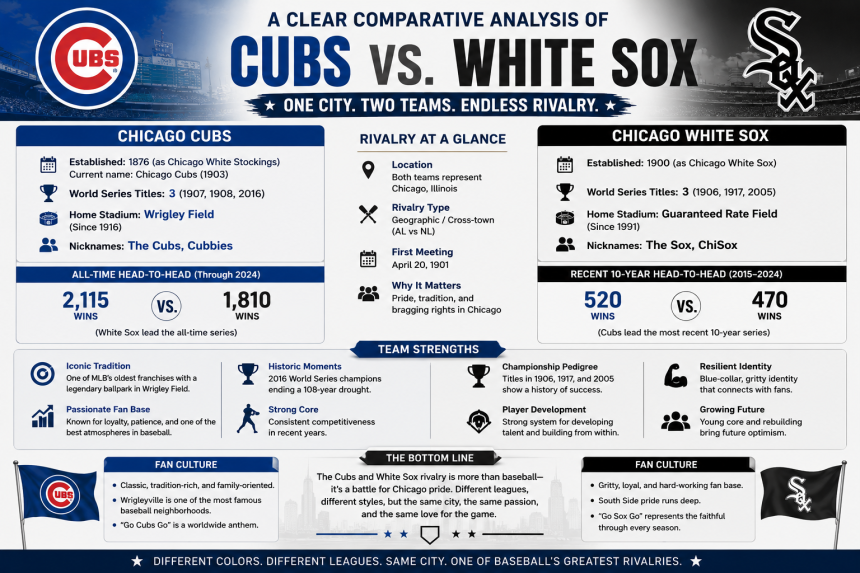
The Cubs lead the all-time series between the teams. The overall head-to-head record is 1,171–960 in favor of the Cubs, with the Cubs holding a 112–97 advantage since interleague play began in 1997. The two teams have met in the postseason twice, with the White Sox winning the 1906 World Series in six games and the Cubs winning the 2005 National League Divisional Series in three games. The number of championship titles and pennants won by each team is shown in the following table:
Team World Series Titles NL Pennants AL Pennants
Chicago Cubs 3 17
Chicago White Sox 3 2 7
In the early decades of the rivalry, the more successful Cubs had a “swing and miss” style of play, while the White Sox reflected the era’s fascination with speed and small ball. Until the middle of the 20th century, the Cubs generally had more success in ownership and management; however, starting in 1954, under owner John Allyn and later general manager Frank Lane, the White Sox began spending more on scouting and development and risking trades that other teams would not have.
Several seasons stand out in the history of the rivalry: 1912, with five Cubs wins making up one of the White Sox’s worst seasons; 1939, when Bill Veeck gave away $500 in cash and food as part of his “Veeck-or-Major-League” promotion for the White Sox; 1956, when the Cubs became the only team to win all six games between the sides in one season since they first met in 1880; and 1967, when the Cubs, leading the NL standings for most of the first four months, dropped 19 of their last 31 games to finish in fifth place and thus out of the pennant race. The Cubs lost both ends of a doubleheader in Chicago to the rejuvenated White Sox, which formed the capstone to the latter’s first 30-win season since 1936; the Cubs went 57–55 outside of their games against the White Sox.
4. Fan and Community Impact
The fan culture surrounding the Cubs and White Sox differs significantly. As one might expect, the Cubs' strong national following contrasts with the White Sox's more recognizable, local, and often militant image. This disparity in support is most dramatically displayed during Crosstown games. Watching a Cubs home game is a family-friendly affair filled with sunshine, old songs, foam fingers, and kids running around the bleachers. Meanwhile, at Sox games, the increasingly younger crowd sports stylish black clothes and often engages in some type of debauchery. When the White Sox win, these fans love to celebrate at games, and when they lose, there are just as many reasons to have a short-term hangover.
The rivalry between these teams is unique because of the animosity it generates considering the record books. Their head-to-head matchups can never live up to the city's expectations given the White Sox's poor championship habit. Nevertheless, the routine date is still more exciting than a game against the Royals or Guardians show. Cubs fans taking over the South Side for three days also brings out the best and worst in these fans, since it is often the only time they get to see their team live. The feeling of the stadium is entirely different when either team is playing as the "home" team. On those days, it is Chicago Cubs teams versus the world in spite of playing in a White Sox stadium. The result is a whole different operation for the police departments involved, bus companies, and neighborhood schools.
5. Economic and Media Factors
The Cubs and White Sox also differ in attendance, resources and revenue distribution. Despite the general perception that the Cubs “own” Chicago in terms of attendance, the truth is more complicated. The White Sox, whose attendance tends to lag, were first in Major League Baseball in 2000, ahead of the Cubs; in 1991, 1992, 1993 and 1999, they were clearly second to New York in the American League. Both franchises have made substantial profits in recent years, but the White Sox are more dependent on Major League Baseball’s shared revenue system than the Cubs and Yankees. One way to overcome the disparity is through winning. In July 1994, White Sox owner Jerry Reinsdorf stated, “How can we get more fans to come to our games? Only by winning. We’ve had our chances, and we haven’t come though.” On the Cubs side of the equation, Mike Ditka’s assessment that “he Cub fans are great—they come out whether they win, lose or draw” has certainly helped sustain and increase the value of the franchise.
Cub and White Sox interaction is also framed by the media coverage of the two franchises. With the newspapers and radio expanding coverage of both teams and the White Sox acquiring 35 games per season on Channel 44, a group of fans came to consider the White Sox “our other favorite team.” The expansion of the games on radio, often televised, and the White Sox victory in 2005, changed the local sports language. Unlike the 2003 season, when reports heralded that, “the team with the best record in baseball had to be back in the World Series,” the 2005 season did not mention a second team as being in the World Series. Both franchises came to consider each other a familiar rival, but not a more heated one than the others in their respective leagues.
6. Cultural Significance
Symbols unique to each team help define the rivalry. The Cubs use the bear mascot, while the White Sox use the South Side Hitman as a representative symbol. Other than those, both teams have local-style legends that fans follow or even believe. For example, the legend of the “curse of the goat” still haunts the Cubs. Rumors suggest that William “Billy” Sianis, a tavern owner on the Near North Side, took his goat to a Cubs playoff game at Wrigley Field in 1945. When Billy was told that animals were not allowed in the ballpark, he became angry and stated that the Cubs would never win another World Series. Fans out of the Dominican Republic also mention a goat curse for the White Sox.
The Cubs and White Sox have accompanied major sporting events through the years. The most striking of these occurred on September 24, 1906, in Philadelphia. In this famous year of rivalry domination by the Cubs — 116 wins compared to only 36 losses by the South Siders — the two teams met at the “World Series” to capture the pitcher’s crown. An odd-ball match was played, with neither team fielding its best players. It was for situational purposes only. But the game caught the fancy of gamblers eager to pocket large wagers in a city with no major league baseball teams. The Cubs won the contest by a score of 36 to 7, with their best player, one-eyed Barrett, bragging: “Boys, there was a pace today!” These remarks were unintended, of course. The real and important thing took place in Sheboygan, Wisconsin. The collection of local roots said to have enough baseball in their small brains to fill a continent raised one slip to interest about twenty of their friends. The gambling went beyond the heat of sport. It had turned real, tainted, filthy.
7. Key Moments in the Rivalry
Countless moments shape a sports rivalry: games, series, trades, off-field drama. The following events are among the most pivotal in the Cubs–White Sox rivalry. Each carries considerable weight, and taken together, they reveal broader truths about baseball culture in Chicago and about the city itself.
1868: After losing their first game as the White Stockings, the team wins the following 13. But amateur Chicago clubs are wary and refuse future matches. The Stockings play their games at the local Armory and level a challenge to any team wishing to take them up. No one does.
1900: The White Stockings drop the White from their name. In 1901, they reportedly become the first team to pay players at a set salary instead of a percentage of the gate receipts.
1906: The Cubs win 116 games to the White Sox’s 93 and take the pennant by a comfortable margin of 6 1⁄2 games. Yet manager Tommy McCarthy becomes increasingly ill. The Cubs lose the Series to their crosstown rivals, marking the first time two Chicago teams in the major leagues meet for the championship. Important players from the Series are the Cubs’ Three Finger Brown and the Sox’s Ed Walsh.
1910: The White Sox become the first team to fly white flags emblazoned with the words “World’s Champions,” despite having won only one Series and virtually all the world-champ status the Cubs picked up on 1906.
8. Differences and Similarities
Team owners and management approach the rivalry with differing goals. From the outset, the White Sox have had an “all-business” style, favoring a cutthroat mentality that some fans and media regard as antagonistic. This ruthless pursuit of championships drives the team to consider both trading and acquiring players from the city’s other club, as in the memorable trades of 1915 (1B Fred McMullin), 1972 (OF Tommie Agee), and 1986 (pitchers Ken Kravec and John Dopson) that sent players out of or brought them into Chicago. In contrast, Cubs fans expect the team to win, but not necessarily to devote every resource to building a contender. The Cubs’ overall operating strategy, which emphasizes optimizing revenue rather than maximizing wins, is accepted by many supporters who enjoy the buzz surrounding Cubs games and revel in the pageantry of Wrigleyville.
While the prospects of a Sox world title bring joy to their supporters in the city’s South Side neighborhoods, Cubs fans feel nostalgic, taking the Sox’s success as bittersweet reminders of their own team’s long championship draught. When a White Sox world title looms, the media narrative often revolves around what it all means for the Cubs. A successful White Sox team stirs interest in the North Side, where casual fans are drawn to their heated cross-town rival. On game days, the commercial excitement is clear both in the South Side residents dressed in White Sox colors around US Cellular and in the North Side fans donning Cubs apparel near Wrigley Field. The two clubs coexist as improbable polar opposites in a baseball-mad town that—whether they like it or not—often mouths the words “Cubs!” and “Sox!” together.
9. Future Outlook
The future of the Cubs–Sox rivalry remains uncertain. The Chicago market is significant, but Cubs attendance trends appear troubling. The Chicago Bears will dominate Chicago sports headlines until January 2024 at least, and the fierce competition with the other Chicago teams—most notably the Blackhawks and Bulls, but the Fire as well—has been intensified by the development of the new Soldier Field. The Cubs have invaded the White Sox territory by not only owning a bigger market but playing better. It is very difficult for the White Sox to attract fans on the road when they are in last place; thus, they do not attract the attention of neutral fans.
The intensity of the rivalry depends on two key factors: Milwaukee and the quantity of young fans in Chicago. The greater the number of Cubs playing at a good level, the more significant the attention they receive from the media, and when they attract the neutral fans on the team, the atmosphere in games against the White Sox heats up. However, the level is determined mainly by the quantity of good players. Those good players make a significant difference and the importance of the games shape that rivalry. An electron–hole collision when the two teams are close in the standings represents the greatest joy in the games against the Cubs. These moments become classic of the season with Cubs sweep a two- or three-game visit, or White Sox win all; the joy appears from one side or the other.
10. Conclusion
The Cubs–White Sox rivalry exists as a constant in a world of change. Many aspects have developed differently over the past century. Attendance for interleague games, for example, is at an all-time high. No other team from either franchise has ever made the playoffs while finishing behind their crosstown opponent. Steep inequalities in investment and results periodically shift the fans’ expectations, although the media and Vegas bookmakers never lose sight of the Cubs’ positive — and the White Sox’ negative — margins. Geography and history prevent them from becoming mere neighbors like so many others.
Yet these contrasts do not disqualify the games from being true rivalry contests. Cubs fans in every decade have pretended that Cubs victories over the White Sox are of greater significance than those over any other opponent; and the White Sox fans, more accustomed to celebrating the serious pursuit of baseball excellence, have reveled in whatever little weight their crosstown games might carry. The official narratives of the teams’ seasons are full of constant claims — whispers of that awful game in September 1959, the glorious backing of the other team’s chance for glory in 2005 and 2016 — that bolster the underlying truths of the rivalry. Even major trade-deadlines moves have shaped the outlook of the crosstown sets: the one that sent Fred McGriff to the Cubs and Carlos Lee to the White Sox made the fans of both teams happy that September.