
An analysis of the historical performance and rivalry between the Spurs and Timberwolves in the NBA.
Historical performance and rivalry between the San Antonio Spurs and Minnesota Timberwolves in the NBA
1. Introduction
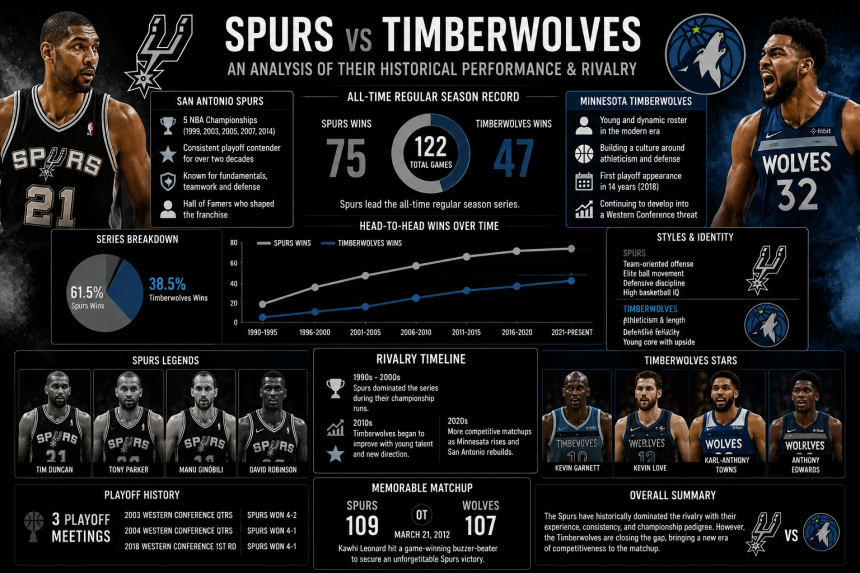
The rivalry between the San Antonio Spurs and Minnesota Timberwolves highlights two different paths that met in the National Basketball Association (NBA). This analysis of early encounters and key rivalry games shows an initial imbalance that evolved under changing circumstances. The Timberwolves joined the NBA as expansion team 1976-77. Having established themselves as one of the best franchises with player like David Robinson, the Spurs struggled to defeat the expansion Timberwolves. Following owner Red McCombs’s shift to basketball after years with the pro football Vikings, the Timberwolves built a competitive team with breakthrough picks Kevin Garnett in 1995 and Sam Cassell in 2000. From 1995 to 2005 the two teams regularly faced each other in the playoffs. Recent controversies have increased focus on the growing distance between the two teams.
The teams first met in the November 4, 1990, in a 100-95 victory for the Timberwolves. No player from either team scored more than 24 points. The Timberwolves won the second encounter, but that would be their last regular-season victory for security games. The Spurs produced the first lopsided contests, defeating the Timberwolves 114-100 on January 7, 1991, ending a six-game losing streak. Spur rookie David Robinson (24 points) and Timberwolves rookie Christian Laettner (21) both peaked, while a third rookie, Popeye Jones (18), scored a season high for the Timberwolves. Spurs rookie Sean Elliott opened the season with a 16-point average but scored just 29 points in the next four games when ill; he rebounded to 20 points in this game. The Spurs would dominate with eight victories by at least 20 points, including 101-74 at Minnesota and 115-88 at Dallas until the Timberwolves began rebuilding.
2. Early eras and initial matchups
The successes of the Spurs from 1999 to 2014 overlapped with four years of postseason contention for Minnesota, culminating in a ferocious duel during the 2004 playoffs. For more than a decade thereafter, San Antonio assumed the role of league paternal and Minnesota all but disappeared from the NBA map. The Spurs had won three of their first four postseason matchups against the Timberwolves—clashes associated with mutual growth and lingering competitiveness. The two teams would clash only five more times over the next five seasons, with only two of those encounters remaining relevant in the larger playoff picture. Nevertheless, several recent streaks, maneuvers in the management suites, and trades on the player level fuelled rumblings of a new rivalry.
The Minnesota Timberwolves joined the NBA as an expansion franchise for the 1989-90 season. With rookie phenom David Robinson holding down the paint, the Spurs entered their 1990 matchup in the midst of a demanding five-game road trip. Adding to the challenge, both Giannini and Robinson had missed the previous meeting between the teams, an early-season contest in San Antonio. Although the Spurs jumped out to a 30-13 first-quarter lead, the Timberwolves never surrendered. With three minutes left, a final basket by Mikhailov closed the score to 118-114 and set the stage for a torrid finish. Kevin McHale's three-pointer with 38 seconds to go gave Minnesota a four-point cushion before Robinson found Terry Cummings on an open drive to the hoop. The Wolves then forced a turnover and lost out when Campbell missed a pair of free throws.
3. Peak years and key battles
The rivalry between the Spurs and the Timberwolves peaked around the beginning of the current millennium, but their games during this period were of limited import. Games from 1996-97 to 2003-04 featured three 80-win seasons between the teams, with San Antonio winning a playoff series in 1999 and four of the six regular seasons. Although the matchups remained somewhat competitive, as shown by a 20-game split of 15-5 in favor of the Spurs, the Timberwolves were a solid but unspectacular squad in those years. They finally escaped round two in 2004 and began to attract more public interest as they chased the Spurs, successfully gaining two more contracts, than just the games themselves.
During the latter half of that era, the media narrative surrounding the rivalry and much of the teams became driven by the Timberwolves’ struggles to reach their first NBA finals before the Big Three condition became fully established in the NBA and Kevin Garnett—who by consensus was the most important player during the league-mandated stoppage of the 1998-99 season—moved on. Even though the Spurs and Timberwolves did meet in a similar situation two years later, the consequence of that playoff series was increasingly appears to be linked more to other teams, namely the Dallas Mavericks, rising to reclaim their previous heights following the drunken stupor of the early 2000’s and Kevin Garnett eventually moving on to Boston shortly before winning an 18th championship than the final games played on the North Star State by the league’s remaining most important player.
The established outcome of their playoff appearances during this period did appear to sow signs of dysfunction and division within the Minnesota franchise as the continued search for a championship-ring-worthy roster emboldened management to display an increasingly opportunistic culture seen previously during the 1970’s and early 80’s.
4. Head-to-head records and trends
Overall, the Timberwolves hold a very slight edge in the win-loss record between the two teams, especially at Target Center, where the two teams have met one time in the playoffs and the Spurs are 7-21, compared to 38-17 at home. These results suggest that the Timberwolves have historically been better than the Spurs even during different coaching tenures and styles.
In the early 2000s, the Timberwolves were often considered the closest competition for the Spurs after the Lakers, but rarely gave the Spurs much trouble in the playoffs. However, throughout the early 2010s, the Spurs owned the Timberwolves until Ricky Rubio was drafted, and the teams played closer games in that period. The combined records from 2011-12 until 2016-17 followed the coaching patterns, with the Spurs winning all but two games against the Timberwolves during Rick Adelman’s last year and the first two years of Tom Thibodeau’s tenure. However, the Timberwolves regained the advantage in the subsequent seasons.
5. Rivalry factors beyond wins and losses
Public and media narratives—beyond the game results—have contributed to the rivalry's intensity. Examples include former Spurs player Richard Jefferson commenting on the Timberwolves before a 2013 game ("other than Kevin Love, who do they have?"), the then-Spurs roster making fun of a Minnesota win ("you can't say you've arrived") and future Hall of Famer Tim Duncan saying before a playoff matchup that "it's always good to have the home games in a series," inadvertently highlighting the opposing team.
Rivalry dynamics were further impacted by significant transactions. After the Spurs selected Saint Mary's guard guard/forward Nando De Colo in the 2009 NBA Draft, Timberwolves president David Kahn traded a future first-round pick to move up one position and pick North Carolina forwards/centers Jonny Flynn and Tyler Hansbrough. Following another transaction that year, Celebrity Boxing staged a boxing bout between Timberwolves player Chris Richard and San Antonio cheerleader Melissa Ford. Richard's victory, and the contrasting fortunes of both teams during that era (the Timberwolves went 25–157 in those two seasons), provided interesting narrative fodder for the rivalry.
6. Impact on teams and players
Beyond the win-loss record, the Spurs-Timberwolves rivalry has shaped team direction and influenced careers. After a decade focused on the Timberwolves, attention shifted with Duncan’s entry into the league. Minnesota’s coaching staff sought a clear-cut methodology, reflected in a series of decisions. With the seventh overall pick in 1998, they selected Rasho Nesterović, a promising but inefficient rookie from the University of North Carolina. General Manager Kevin McHale mortgaged Minnesota’s future with the Latrell Sprewell and Sam Cassell trades, using up first-round picks that could have coupled with the numerous second-round picks acquired in the Nesterović trade. Nesterović’s defensive lapses were exposed as the seasons progressed.
The win-loss record showed the teams’ peak head-to-head performance, but despite this, players and fans resonated with a softer and unquestioned divisive rivalry. The emergence of internal strife in San Antonio during the 2006-07 season was a blemish in team history, but minimised by the culture that covered the Spurs for so long. The arrival of Mike D’Antoni and his Seven-Seconds-or-Less philosophy at the helm of the Phoenix Suns threatened the dominance of the Spurs in the West for a couple of seasons, but these were largely expunged by the striking injuries that affected the Suns roster. With Parker, Duncan and Ginóbili sharing the league MVP distinction during four seasons, their winning record vs the Wolves greatly boosted their candidacies.
7. Conclusion
During the late 1990s and early 2000s, the teams in the NBA’s Western Conference with directly opposing trajectories were the San Antonio Spurs and the Minnesota Timberwolves. While the Spurs developed into a championship-caliber team around a core comprising Hall of Famer David Robinson—later supported by future Hall of Famer Tim Duncan—Minnesota was attempting to build a playoff contender seeded by its own rookie of that year’s draft, Kevin Garnett. The differences in fortunes made these squads rivals in name only for a time. Yet as their paths intersected through tightly contested regular-season games, a true rivalry began to blossom. The Spurs achieved their breakthrough success as Minnesota’s climb culminated in yet another pre-playoff collapse. The narrative deepened in 2003, as the teams faced off in the postseason for the first time only for successive years of defenseurting play on the Timberwolves’ part to dim their momentum. Two seasons shortened by a lockout would again alter the course of the rivalry, shifting it from one based on head-to-head contests to one fueled more by off-court elements.
Although the Spurs-Timberwolves rivalry was ultimately characterized by an imbalance in head-to-head performance, factors beyond the win-loss records also played a significant role. Coach Popovich was determined to reshape Minnesota’s playing style and even attempted to recruit Garnett to join Robinson and Duncan. Trades had already eliminated the first of these selling points, as off-court issues with the yet-to-establish Spurs had led to the dismissal of former Sixth Man of the Year Vinny Del Negro from the franchise. With all these previous subtleties of the rivalry now aligned, only the final head-to-head battle remained to be fought; thus the next major chapter in the Spurs-Timberwolves saga would again focus more on eventual trades than matches.