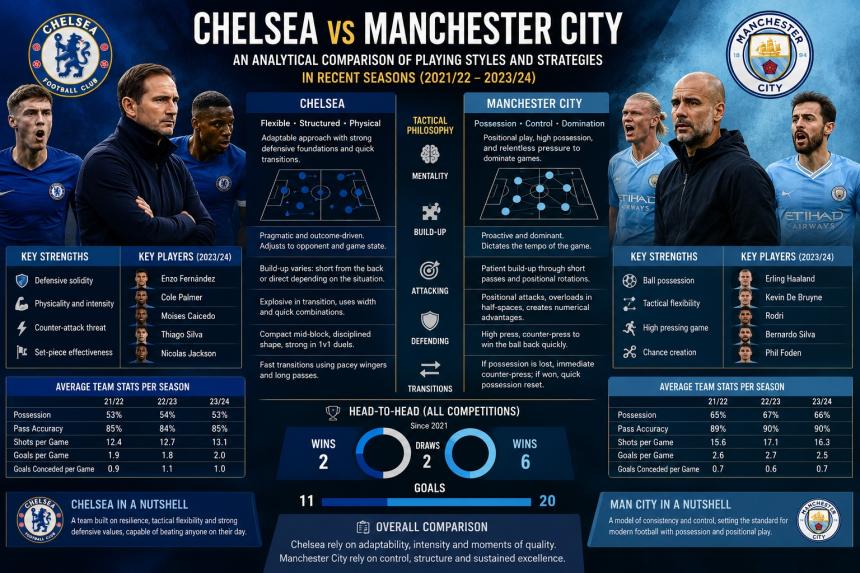

An analytical comparison of the playing styles and strategies of Chelsea and Manchester City in recent seasons.
Comparative analysis of Chelsea and Manchester City's playing styles and strategies in recent seasons
1. Introduction
Chelsea and Manchester City have contrasting playing styles: Chelsea’s game relies on a pragmatic match-by-match adaptation of tactics, line-ups, and player roles to suit opponents, whereas City’s philosophy adheres to control of the ball through possession and pressing. This analysis centres on the playing systems employed in the 2021–2022 season and the start of 2022–2023. Chelsea tended to form a 3-4-3 or 3-4-2-1 formation at the back to offer extra protection, with a pair of attacking wing-backs, and utilised a double pivot in central midfield to facilitate fast ball progression. These players were integral to the team’s defensive shape, often playing more of a box-to-box role, with balance still coming from midfield and the inverted wingers being primarily responsible for goal involvement and threat. By contrast, Manchester City predominantly adopted a 4-3-3 formation to dominate possession, with attacking flexibility and creativity built into the line-up.
Chelsea’s more adaptive approach was evident in the use of wing-backs in both the opening match of the 2021–2022 season and again only two matches later, with a double pivot sitting deeper alongside the centre-backs. City’s playing philosophy faced a test in mid-November 2021 when a first-choice centre-back was missing. The wider squad was not being used frequently throughout matches, despite the ability of both key players and reserves to execute each tactical plan. Of particular interest for City was the need to adapt performance for the November match against the then-champions and title rivals, particularly given the opposing club’s demonstrated ability to take points off for City in the past despite being outplayed on most occasions.
2. Team Philosophies
Philosophies shape performance. Chelsea adapt to every opponent, playing highly distinct matches. City impose their approach consistently. Most teams strive for a middle ground, balancing adaptation with a favoured style, yet many current Premier League outfits, including Arsenal, Tottenham, and Liverpool, closely align with one or the other. Chelsea and City display the biggest contrasts.
Chelsea’s key strength is flexibility. Every starting XI is tailored for the opponent, sometimes resembling an entirely different formation. Positioning, pressing triggers, passing patterns and combinations, and even individual player roles shift from match to match. Tactical identity is minimal; the only constant is that the players know precisely what is required each time. Manchester City are the opposite. Pep Guardiola demands near-constant positional play, with set structure and specific roles throughout the team—almost a guidebook for when and where to move. They strongly prefer controlling matches through possession-based attacking yet have shown more adaptability during their current title reign.
2.1. Chelsea: Adaptation and flexibility
Chelsea’s recent style differs markedly from that of Manchester City. Thomas Tuchel and Graham Potter have applied a pragmatic approach, focussing on the tactical weaknesses of opponents, adapting shape, structure, and principles accordingly. Tuchel settled on 3–4–3 as his base formation, preferring a five-man defence out of possession. As the season progressed, traits began to emerge which were particular to the Chelsea players and their manager, a balance-requiring, Ortega-conscious club shape without the ball. Achieving this defensive cohesion has become the priority, remaining compact and denying space through the centre. As a result, opposing attacks rarely approach through the middle third, a key area for Chelsea’s defenders in regulating the attack.
City, Mané, and Real Madrid grab the most headlines, but Chelsea’s focus on closing down space centre-to-wide, density out of possession, and achieving stability—the wearing down of the opponent, aerial dominance at both ends, and danger on the break—produced better season stats. Having secured the best defence in England, conceding the fewest expected goals, conceding the lowest percentage from shots, keeping the highest number of clean sheets, and allowing the fewest touches in the area, the team remained strong, entering matches with Leeds, Southampton, Leicester, and the FA Cup final boasting the best goal difference in the Premier League era. These statistics translate into winning positions, but undermined the freshness needed to convert the chances created in matches against Liverpool and Real Madrid.
2.2. Manchester City: Possession and pressing
Manchester City have aimed for a culture of consistent attacking play; Guardiola prioritises ball possession, pass volume, and pressing. The team often dictates possession, pressing in zones to win back the ball and exploit opponents.
The 4-3-3 formation has become consistent, with wing-backs inverted in attacks. Players’ patterns are automatic but fluid; central players diverge positions, creating numerical advantages and progressive spaces. Ball progression involves forming triangles, manipulating defence serrated for overloads in exposure. Central rotation creates a massive overload; wingers’ positioning shifts defenders, assisting lunating triangles for breakthrough passes.
The team’s defending structure disrupts opposition build-up; immediate pressure blocks aerially accurate distribution. Exploiting shooting triggers cause intervals between man-oriented pressing. Pressed players expose ball carrier’s head-down position while nearby players limit options; players sprint to cover space, denying direct central passes. A settled shape retains control. Functional familiarity strengthens positional centre for compactness or regained control after circulation. One touch caused by lack of control precision and body orientation reduces counter-press efficiency.
Set-pieces maintain defensive organisation; positional awareness protects spaces between individuals. Defenders and pressers hold body orientation for successive recovery phase orientation. Counter-press focuses on regaining shape; nearby players flocking to the ball causes committee overloads on loose balls, enhancing regaining and progressing. Counter-attacks exploit defenders’ late recovery.
3. System and Tactics
Chelsea and Manchester City demonstrate contrasting playing styles and tactical systems. Chelsea have often tailored their approach to suit opponents, prioritising shape over impressive passing statistics. Manchester City have consistently pursued a possession-oriented style, using positional play to stretch rivals horizontally and vertical passing to expose them.
Formations have shifted, particularly in response to injuries, yet shape remains fundamental: Chelsea often defend in a 5-4-1, while City maintain a 4-3-3, with wing-backs who press high upfield. Ball progression starts from the back, with Chelsea relying on long passes into wide areas or behind the last line, aided by rapid wingers. City employ a more intricate approach, often working the ball into wide areas before creating central overloads for vertically played passes on the final line.
Pressing strategies differ markedly. Chelsea initiate pressure in the opposition half through an energetic front three and two adventurous wing-backs; the rest contribute by maintaining compact lines and closing down space. City generally defend a little deeper, springing into an aggressive press on regaining possession but also showing restraint to deny opponents the chance to counter-attack. While their back four remain relatively conservative, their pressing is highly co-ordinated, with players reading one another’s triggers for a group response. Once the ball enters a wider zone, City cluster to win it back, opening up passing angles for immediate transitions.
During defensive phases, Chelsea often shift into a 5-4-1, maintaining this shape even when the opposition are deep in their half and the ball is situated within a channel. This solidity has enabled them to be difficult to break down, despite a failure to preserve such discipline in recent big games. City have also relied on an organised defensive structure to soak up pressure; despite their luxurious attacking options, the back four and goalkeeper remain vital in ensuring team resilience.
3.1. Formation trends
According to available data, Chelsea alter their system much more frequently than Manchester City. In the last two completed seasons, Chelsea used ten formations in total, compared to three for City. For Chelsea, there are not just more formations than for City; their use is also less predictable, as four different ones were used more than six times and two in double figures, but only three had been used for at least sixteen games at the end of the 2021/22 season.
In terms of the number of players starting each game in a given position, Chelsea also show greater variability than City. Chelsea had players starting in a specific position in-game on fewer than sixteen occasions for eleven such positions at the end of the 2021/22 season, well above City’s count of five. City tended to retain their standard personnel even during heavy fixture congestion, while Chelsea, by contrast, spread the load across more players. The very nature of Chelsea’s philosophy demands such variability.
3.2. Build-up and ball progression
In possession, the two teams contrast sharply. Chelsea have looked to progress the ball more quickly with longer transitional passes, rather than building from goalkeeper to goal. When going short, they have frequently sought to strike for goal early, especially when wing-backs or central midfielders pushed forward to add a vertical threat. Crossing has been an important avenue for creating opportunities, but sub-optimal creative output from the range of players in these positions has limited the impact. City, by contrast, usually engage in patient, cohesive build-up. When played through Chelsea’s counter-press in recent fixtures, they have demonstrated the ability to transition from back to front expertly within moments, threatening with balls into the area for strikers and midfielders alike.
Chelsea have been robust enough to cope defensively with City’s capacity to up the rhythm of a game. Greater inconsistency and fragility have been evident in City’s performances against other rivals. Their alacrity to engage with the ball and quicken a contest has drawn post-match criticism from Guardiola, who has labelled it a “lack of respect”, admonished his side as “arrogant” or warned against offering superior opportunities in the defensive phase. The latter has been particularly pertinent, with City too easily opened up when being punished for failing to use available ball possession to its fullest potential.
3.3. Pressing and defensive shape
A Marc Cucurella error gifted City an early goal that Chelsea had to respond to. In the mode of a football game goalie, Edouard Mendy moved well down the left. A short pass was played to Mateo Kovačić near the edge of the 18-yard box on Chelsea's left. Kevin De Bruyne rapidly closed him down, and Haaland positioned himself near the progression route of Kovačić's hypothetical pass. Kovačić's next touch was a diagonal pass towards Reece James positioned roughly at 45 degrees between him and Mendy. As Havertz charged down the right at pace, James's player relationship with Mendy was usually man-to-man. When Kovačić played the pass to James, Mendy quickly turned and sprinted horizontally across the goal. James skipped a shot whilst on the run, but went too early, losing his balance and curling well past the far post.
Just after the half-time point, Kepa Arrizabalaga made a huge defensive error. His film suggested he was gaming as if Chelsea were transiting into a 3-5-2 after their goal-kick!! Astutely monitoring the bounce of the ball, Erling Haaland dashed past the Chelsea defence on his left. Josko Gvardiol, perhaps Chelsea's best defender on the day, automatically stepped forward to screen and cover the route to goal for Arrizabalaga's goal-kick. Their second pot of data suggested Kepa was mind-gaming a distribution option to his fellow Spaniard. Gvardiol game-failed to defend Haaland strong; Arrizabalaga failed to deliver a procedure error in Hale's direction; Mudryk failed to stop or slow Haaland's run; and too several defenders failed to close down City's eighth goal of the half.
4. Player Selection and Roles
The differences between Chelsea and Manchester City members and their roles further reflect each team’s playing identity. Chelsea’s squad is multifaceted. It includes talented wingers who best perform using width. Two forwards have the ability to attack centrally through pace, movement, and clever runs, while two others possess superb dribbling to advance high with close control. The midfield offers players with creative passing, ability to set the tempo, and positional awareness for precise defending. Manchester City’s squad is remarkably homogenous. Midfielders dominate. They orbit around the ball, sharing it and joining attacks and defence. Strikers work to create chances for teammates, while its quadruple-playmaker mix severely limits scoring chances.
Away from goal, the core front trio presses opponents, making the area around the No. 6 very dangerous. The wing-backs are under strict orders. The defence buoyantly puts pressure on direct balls, flush to the side-line, but otherwise risk being caught out by well-timed movement in behind. During attacks, the full-backs push up as wide as possible, almost into the opposition’s backline. The central defenders possess the passing and distribution to assist build-up and, crucially, cope with counter-attacks. A goalkeeping style has also developed. No longer merely a final and last-ditch defence, the goalkeeper acts as an extra outfield player — anticipating through-balls, taking potential one-on-ones, and dribbling past rusher or other opponents when necessary.
4.1. Key attackers and midfielders for Chelsea
Chelsea’s main attackers possess diverse skills. Outwide, wingers use speed, dribbling, and creativity to penetrate defences. Raheem Sterling helped unlock stubborn teams with clinical runs exchanged for cutbacks. His strong movement allowed more central pens. Repeat situations generated key chances in the 1–0 win against Brentford, while injury disruptions scattered clear-cut opportunities in later matches.
Central attacking players help facilitate transitions and draw defenders. Kai Havertz deployed as a false nine attracted centre-backs and opened space. His laid-back style and uninterested demeanour occasionally ruffled feathers, but he scored double figures in all competitions, most importantly a goal in the final. Midfielders Mason Mount and Enzo Fernández combined passing quality with hard-running movements to support forward players despite not being pure creators. Mount’s knack for the unexpected caused problems.
In the second part of the season, Chelsea’s coaching change saw more direct play. Goalscoring burdened the wing-backs’ shoulders. Despite huge media destruction of 2021 Chelsea Champions League winner Romelu Lukaku, the Belgian striker joined Inter Milan on loan after a disappointing season. Chelsea fans hoped for a more memorable second spell, although even Lukaku could not control the support’s derision.
4.2. Key attackers and midfielders for Manchester City
Pace and precision power City’s fluid attacking play. Kevin De Bruyne ranks among Europe’s best midfielders. A master of vision and passing, he spreads play to exploit wide spaces, particularly for wingers running onto crosses. Phil Foden relishes receiving in central areas before attacking defences, whether with dribbles, passes, or shots. When fit, Erling Haaland excels with pace, power, and finishing ability. He threatens behind defences, either when running onto through-balls or when making blindside runs towards the back post. With Haaland in the side, City break quickly to capitalise on defensive lapses.
4.3. Defenders and goalkeeper approaches
Recent games and general trends reveal that Chelsea and Manchester City employ markedly different pressing strategies. Chelsea mostly sit in a mid-block and offer moderate ball recoveries, while City generally engage opponents much higher up the pitch. Chelsea focus on controlling transitions, often defending deep and allowing shots from the edge of the box or on breaks. They rarely discard possession needlessly, especially in their own half. As a result, Chelsea have a high expected goals against figures, yet a low goals against figure.
Although showing frequent positional flexibility and great midfield depth, City’s playing style still fundamentally revolves around the principles of positional play. They seek to monopolise possession, pushing for more than 60% while remaining highly efficient in the attacking third. Ball recoveries in the last third are also elevated compared to Chelsea, highlighting the desire to win the ball back as quickly as possible after a loss. Yet when not in possession, City more closely resembles Chelsea, allowing shots from outside the area and the centre as they look to maintain defensive discipline and utilise compactness and stability to initiate quick counter-presses following attempts on goal.
5. Set Pieces and Transition Play
Chelsea and Manchester City emphasize different aspects of set plays. Offensively, Chelsea’s well-rehearsed routines often create quality chances. Defensively, however, the team struggles to maintain organization, relying instead on speed and effort to cover possible weaknesses. City’s commitment to disciplined defensive positioning and focused counter-pressing helps them manage the transition from set plays.
Chelsea typically score more from set pieces than City. Ahead of 2022/23, set-play coaches were added to Graham Potter’s staff. This investment bore fruit. For example, Ben Chilwell’s free-kick against Sassuolo in pre-season, planned and rehearsed, caught the Italian side unawares. During the regular season, the Blues converted six set-piece moves into goals (double the next-best teams) and created more overall chances—despite managing fewer corners than most rivals. Offensively, set plays are thus an area of potential advantage for Chelsea, particularly when rehearsed.
Defensively, set plays present a different challenge. Aerially vulnerable at times, the squad can struggle to organize properly. The depth of the roster means every player is a potential set-play starter, but their deployment tends to depend on current form and fitness. Individual lapses and reduced concentration can lead to concession of a goal from a dead-ball situation. Therefore, when the team fails to close out an attack properly—due to inability to hit the right note in set-play preparation or simple misreading of the movement and positioning of opposition attackers—resignation follows. Opponents then break forward with speed, and the consistency of defensive shape is sacrificed in the chase to prevent an equalizer.
Defensive discipline and counter-pressing remain City’s strengths when defending against set plays. Guardiola requests narrow, compact shape and intense (and often safe) aggression. Players anticipate quickly when possession changes hands during a set-play phase and remain vigilant—especially in midfield—not only to prevent a counter-attack but also to regain possession as quickly as possible. In this action, they expect help from nearby teammates, often including the nearest defender.
5.1. Offensive set plays
Recent Chelsea managers have employed attacking set pieces less as a key strategy and more as a supplement to their tactical toolkit, maximising the aerial threat offered by tall players such as Kepa, Thiago Silva, Benoît Badiashile, and Roméo Lavia. City have been more consistent in making set plays a primary