
Exploring the Historical and Cultural Significance of Iran
The Historical and Cultural Significance of Iran
1. Introduction
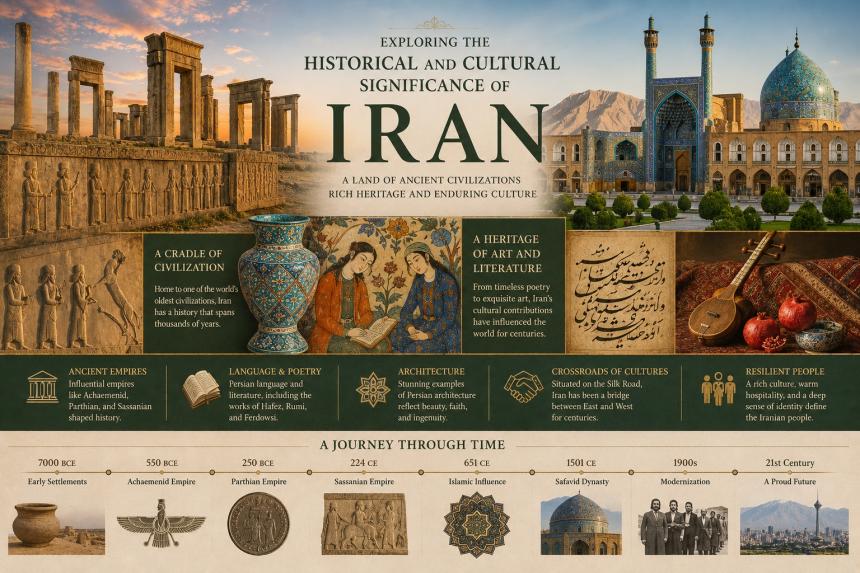
Iran historically known as Persia, is among the oldest countries in the world. Its recorded history goes back to 5000 years. The Iranian plateau was the birthplace of one of the first civilizations, the Elam, which existed around 2700 BC in southwest Iran. Later the Medians and Achaemenids founded the first great Persian Empire, the Achaemenid Empire (559–331 BC). This period was followed by the reign of Alexander the Great and the conquests of the Seleucid and Sasanian empires (AD 224–651). During this period, governance and power were centralized in the Persian Empire, and the Persian language became the spoken language of the Iranian plateau. With the advent of the Islamic religion, especially the coming of the religion of Hamid, the Saites, like the land of Persia, touched religion with the power of Zoroastrianism. These two religions deeply affected each and every thought of the people of Iran. The Iranian plateau was the cradle of many of the world's literary and intellectual greats. It was the birthplace of great people of very high caliber like Aesop, Xanthus, Zoroaster, Khayyam, Rumi, Hafiz, etc.
Language and literature are the ornaments of the nation. Language captures the thoughts and feelings of the people and expresses their happiness or sorrows. The prose and poetry in the Persian language have a quality to express even the complex feelings with absolute ease. The culture and life of Iran were divided into many different societies; every society followed its own style. In the field of music, architecture, and arts like calligraphy and ceramics, Iran is extremely famous. Many festivals like Nauruz are associated with the months of the Iranian calendar. The now-vibrant Iranian culture is not a different culture that originated suddenly; rather, it is the mixture of all the great cultures that originated for the past hundreds of years.
2. Early History and Civilizations
Iranian territory comprises the ancient lands of Persia, Media, and Elam. The first civilization in Iran was in Elam (3500–600 B.C.), which left baked bricks, the first form of writing in Iran, and a collection of terra-cotta statuettes from clay, stone, and ivory. The Medes (678–550 B.C.), led by increasing power in the region, succeeded the Assyrian Empire. They founded the second great power in the region and were unified into a great kingdom by King Cyaxares. Within two generations, the Medes became a great power and helped the Babylonians bring an end to the Neo-Assyrian Empire. The Achaemenid Empire (559–330 B.C.), founded by Cyrus the Great (Cyrus II), was the greatest in ancient history, stretching from the boundaries of India and Central Asia to the borders of Egypt and Ethiopia. It was the first stage of history that laid the foundations for the formation of the Iranian nation and culture. During this period, the Persian language flourished and became the language of power in the great Achaemenid Empire, and the Gatha, Yassna, Yassna-Haptang-Hatim, and Yassna-Fravardine became the highest values of the language. The grandeur of the Achaemenid Empire and the cultural bond of the people made it the most glorious area of the Ancient World.
Iranian territory was home to several important pre-Islamic civilizations. Elam (3200–639 B.C.) was a majority language in ancient Persia. The Elamites were also defined as an Indo-European people and contributed significantly to the Achaemenid civilization (558–330 B.C.) and, later, to the Zoroastrian religion. Two important artistic and monumental centers, Susa and the surrounding region, still reveal paintings, carvings, and monumental structures. The ancient region of Media is rich in Zoroastrian mythology. Southwestern Iran was the heart of ancient Persia and the birthplace of the Achaemenid Empire, the first Persian empire governed by Iran. Iran's Achaemenid architecture, sculpture, and inscriptions continue to inspire many artists within Iran and throughout the world. The Achaemenid Empire and later the Sasanian Empire (224–651 A.D.) were followed by the emergence and spread of Zoroastrianism, which for centuries would be the most important and influential religion in Iran and would influence Judaism, Christianity, and Islam as well.
3. The Persian Empires
The Achaemenid and Sasanian empires were the two great Persian empires. Their governance encompassed most of present-day Iran and extended to vast areas of Eurasia. The Achaemenids ruled a multicultural state for about 220 years before being conquered by Alexander the Great. The Sasanian Empire lasted about 425 years, was the last powerful Iranian state before the Islamic conquest, and was involved in a prolonged war against Byzantium. Economy, administration, culture, and religion were more developed in Iran than in its neighboring regions, such as the Arabian Peninsula, since ancient times. The legacy of both empires influenced subsequent Iranian history and much of world history.
The Persian Empire had a highly developed infrastructure of administration, communications, and transportation, which was essential for managing a vast, multicultural state. They built a road system that surpassed that of Europe until the modern era and established a set of messenger and postal systems. They also developed a politically oriented intelligence system.
4. Language, Literature, and Religion
The arrival of the Persian language dates back to Elamite and Avestan times. Though members of the various Iranian tribes initially spoke different dialects, they grew closer over the centuries and eventually formed a unified bilingual identity. At the forefront of this movement was the Achaemenids' Aramaic inscriptions in both Elamite and, later, in Hieroglyphs. According to contemporary scholars, the Old Persian language became a "NEO-LINGUA," adopted by the various Iranian tribes.
Iran's most famous literature is unprobably Hashar's Shahnameh, but the writings of Shams al-Din Mohammad of Khorasan—better known as Omar Khayyam—are also recognized worldwide. These poets, who written their works in Persian during the Long Seljuq Period and earlier, exerted pervasive influences in the broad realm of Iranian culture and traditions. Though Zoroastrianism had waned as the dominant faith since the advent of Islam, it became popular alongside the spread of Islamic ideals. Muslim scholars not only mastered Zoroastrian scriptures by translating them into Arabic but also regarded Zoroastrianism as the key to understanding the region's earliest history.
However, the Islamic period witnessed even greater interactions among religious communities. Major Persian literary works, written by Shiits, were translated into Arabic. Important Arab Muslim scholars were born into Jewish or Zoroastrian families. A generation later, important Bahai narratives unveiled a new faith combining crucial elements from Zoroastrianism, Christianity, and Islam and tracing its origins to Shiite Islam.
5. Culture, Arts, and Traditions
Iran's historical roots are reflected in its culture. Iranian culture is a compound of elements that are the fruits of the thoughts of centuries of varied peoples living in the greater Iranian land, which extends from the Caspian Sea in the north to the Persian Gulf in the south, and from the Zagros Mountains in the west to the Tarim Basin in the east. The Persian language, in which nearly all Iranian literary works have been composed, has originated in southwestern Iran; but the country has also witnessed the rise of other Iranian languages, such as Elamite, an indispensable link in the chain of linguistic evolution in Iran, and the language of a short-lived but important eastern Iranian literature, among the Mzdean texts.
The song of the reed, as initiated by Rūmī, lives on in the hearts of all Iranians. As with the poet Sa`dī, the quaint and humble utterings of the environment are musical in the compositions of Shāhīr Aāzād, who, from the modest stock of West Persian peasant song and nursery rhyme, has extended the boundaries of the Persian song into the world of play—the play with children, the play of the most delightful fables, and the play of the minstrel. In addition to the work of these poets, folk songs, popular drama, and forms of music and dance current among the Iranian people will not only reach the stage of perennial life but will carry the existence and essence of the people beyond the frontiers of time. For the special qualifications of the Iranians for music and for the love of music and song are as old as the history of this people and continue to the present day.
6. Iran in the Modern Era
From the early 19th century, Iran underwent military and social modernization. A strong reaction against foreign interventions led to the 1906 Constitutional Revolution, which created a parliament and a constitutional monarchy around a powerful Shah. A number of political parties emerged, but the constitution became meaningless after the Second World War with British and Soviet interventions. The rise to power of Mohammad Reza Shah Pahlavi, whose government was supported by the United States and Great Britain, was strongly opposed by many groups. He pursued a radical, Western-inspired modernization program while ignoring many traditional institutions and values. His government ruthlessly suppressed opposition and enjoyed considerable international prestige. Nevertheless, it faced a serious crisis when the main political opposition left the country and was replaced by the Ayatollah Khomeini's Organisation of the Islamic Revolution.
Despite the country's rich oil reserves, which made it one of the world's greatest oil producers and also the fifth site of oil reserves, the regime was unable to solve Iran's longstanding economic problems. Control of the oil industry was removed from the British and placed in the hands of the Iranian government, thus enabling Britain and the United States to overthrow Prime Minister Mohammad Mossadegh, who had brought about this change; his assassination marked Iran's first and only experience of independent politics in the 20th century. Labour unrest increased as Iran's quest for military and industrial modernization once again failed. The Iranian educational system emerged as a fruitful source for Western and East European universities; great metropolises like Tehran expanded tremendously in size and accommodation.
7. Iran's Global Influence
Cross-cultural exchanges have been a constant feature of Iranian history. During ancient times, Persian traders established economic and diplomatic relations with people in the Mediterranean region, Central Asia, the Indian subcontinent, and East Africa. The demand for Persian rugs, silks, and other products supported a flourishing trade along overland and maritime routes. However, it was only after the establishment of the Achaemenid Empire and its long-term control over vast territories that Iran became an important transit zone for traffic between the East and West. Western merchants used Persian territory to import luxury goods and spices. Key Persian cities like Persepolis, Susa, and Babylon became crossroads where persons from different nations met, interacted, and left their imprint on one another. To communicate with their devoted Iranian subjects, the Persian kings employed the local dialect-and-script of Elamite. The Greeks and Romans used these channels not only to acquire goods and precious stones but also to acquire ideas about organized state governments and military conquests stemming from the Persian Empire.
Throughout their recorded history, Persians have been producing poetry that reflects their concerns, fears, anxieties, joys, tragedies, and triumphs. When the region came under Islamic influence in the 7th century, Persian poets and scholars were the first to produce a scholarly and literary corpus in Arabic, thus forming an intermediary bridge between Classical antiquity and the Islamic world. Persian had become the language of scholarship and literature for many Muslim regions outside Iran, and Islamic science and philosophy thus found expression in Persian with the development of masterpieces of literature, art, and philosophy.
8. Challenges and Continuity
Throughout its history, Iran has faced numerous challenges, especially from neighboring countries. Yet, its great civilization, culture, and traditions have remained intact and have resurfaced again and again despite the adversities. The Iranian nation finds itself at a historical and cultural crossroads. Iran modernized and improved its education, culture, science, industry, and political structure more than many neighboring and regional states. Yet, the widening gap between the contemporary world and Iran’s deep-rooted traditions has posed a dangerous challenge to the identity of a nation with one of the oldest histories. Sanctions have practically paralyzed the economy, and the country has experienced civil wars and serious upheavals. Such events are not in themselves fatal; on the contrary, they provide opportunities for the emergence of dramatic alterations.
Iran's culture and civilization continue to evolve with time, remaining true to their roots while adapting to new realities. Indeed, the influence of past and ancient traditions can be seen in the music, paintings, and miniatures of present-day Iran. The culture of daily life, family structure, and religious and public rituals still share common points with age-old traditions. Some of the festivals, especially the New Year, remain preserved as in the past, while handicrafts, food, and dress retain certain regional characteristics inherited from the distant past. The creation of new forms in dance and music on the basis of ancient Persian traditions has invigorated these two artistic genres.
9. Conclusion
The significance of Iran may be summarized in four unifying ideas. First, numerous major historical forces have irrupted, crossed, shaped, affected, and/or influenced Iranian lands. This has created, and continues to create, a site of rapid change. It may be considered, thus, a nexus of change within, and from which long-range evolution may be observed, perceived, or identified. Second, as change within Iran has reflected – and, in some cases, anticipated – changes throughout the world, it is possible to suggest that a good understanding of Iranian history may, to an extent, inform an understanding of world history as a whole. Third, ideas have been constant, not only throughout Iran’s history, but also present in, and influential upon, the world. The migrations and movements of ideas and thought between cultural, religious, ethnic-administrational, and neighbouring-artistic customs is reflected in trade, the great Faiths, literature, music, artistic styles, and religious structures of the civilizational cores along the way. Fourth, the strength mirrored in Iranian souls, especially in the minds of women, and the great artistic and craftsmanship talent seen throughout four millennia of continuity have lent a beauty and elegance to traditions, artworks, architecture, lifestyle, language and literature, calligraphy, ceramics, music and every single moment of life from birth to death.
The peripheral existence and tensions with neighbouring lands – political, cultural, and economic – have kept Iranian lands a site of change. A clash of cultures, peoples and ideologies these last centuries with a new force, Western modernization, and the resulting attempt to preserve previous values and perspectives have brought great disturbances to these lands. But men have remained men, women women, and the Persian word Dard, "feeling", has remained a tangible, incorruptible quality of the Iranian character, an interior structure, maintained through their greatness of spirit. A greatness expressed in all forms of civilization: Crafts, arts, ideas, literature.