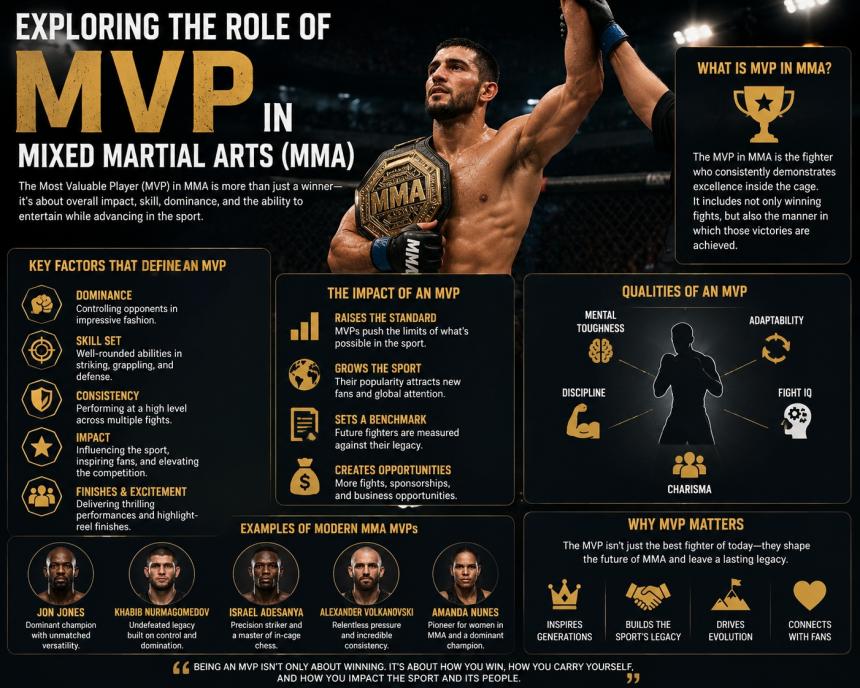

Exploring the Role of MVP in Mixed Martial Arts (MMA)
Exploring the Role of MVP in Mixed Martial Arts
1. Introduction
In mixed martial arts (MMA), the concept of the most valuable player (MVP) provides compelling insights into a fighter’s performance, training focus, talent development, and promotional potential. The application of MVP can enhance day-to-day training by clarifying a fighter’s present needs, informing the planning and execution of higher-level decision-making, mapping skill development, and revealing recruitment priorities. It can also improve promotion by shaping matchmaking choices, marketing narratives, and brand identity. A fighter’s MVP is at the leading edge of his or her ability.
For those not familiar with its meaning, MVP in MMA possesses specific features. MVP is distinct from the other acronyms of most valuable player, most valuable professional, and most valuable person, which describe an athlete whose level of talent, charisma, or rivalry draws the greatest numbers, attention, or revenue for a sporting league. In contrast, MMA’s MVP is a matter of process rather than outcome, usually not officially designated by the sanctioning body or associated organizations. As commonly understood, MVP is therefore a reference to the underlying work that is evident in an athlete’s facilities both in and out of competition.
2. What MVP Means in MMA
Every fighter can display some MVP traits. A general definition could be “performing better than opponents at the core skills and decisions required in a fight - as recognized by the system of scoring.” With this in mind, an MVP, while activating MVP traits, aims to be especially effective at key skills. MVP Concept Skill 1 targets “best” through a wide range of possible applications in the fight, while Skill Use & Effect aims to identify potential influence on every part of fight. Furthermore, MVP doesn’t necessarily imply overall greatest fight ability or output of performance. It also holds an estimated foundational metric capable possibly of measuring weakest fight ability.
Data or people can directly, or indirectly, identify and relate major priority skills, or skills essential to competing at a active sport level, in a sport or possibly a trade. Also recordings or statistics of fighters could also offer help in comprehensively outlining MVP. During a given fight, the degree of strategic MVP being activated and evident in any locations across the fight could also be mapped.
All this is a vital part of MMA since without these people calling the shots, there is no organization. MVP hopefully aids match-makers and promoters directly, but in these areas, it’s mainly humbly used hopefully harmlessly, with awareness of how much attention will naturally be on those areas.
3. History of MVP in MMA
Mixed martial arts has a rich history of fighters using innovative ideas and techniques to gain a competitive advantage. One of the earliest notable ideas was "distance management," a concept that is sometimes relayed as "controlling the space." It's found in Greg Jackson's advice to his fighters in preparation for matches against Anderson Silva, a strategy that later yielded mixed results against Silva. In a sport "invented on the back of Brazilian Jiu Jitsu" but now "dominated by wrestlers," many early training camps seemed still to be trying to formulate effective solutions to deal with grapplers of different sizes and styles. The idea of striking before a grappler even began to shoot, made popular by Vitor Belfort, has undergone iterations; for example, with Jon Jones's areas of the octagon becoming smaller and smaller as opponents tried to hit him with a punch before he was able to shoot for a takedown.
Another idea that traces its conceptual antecedents to other sports – for instance, the "whack-a-mole" defence against capitalising on pre-planned errors in cricket – is "inhibiting your opponent's strengths." Here, MVP isn't just encouraging you to train to malfunction your opponent with fears of set plays, making them second guess watching for something that they've seen you drill hundreds of times in training. It's doing that whilst demonstrating clinical efficiency on your less favoured side. Point fighters have taken the technique to extremes, for example, building patterns to feed their partner's primary work, but slowly and subtly changing the other side in prep for an upcoming bout.
4. How MVP Affects Training and Strategy
Training focuses related to MVP often emphasize situational familiarity and player decision making, while individual and unit conditioning areas look to build safe, predictable MVP advantages. Emphasis is placed on amplifying strengths, minimizing weaknesses, and increasing a player’s ability to make MVP-indicative decisions throughout competition.
Daily routines frequently include drug testing, poor dietary habits are eliminated when possible, and all activities are devoted towards reinforcing one style of play (both on and off). Players will often train within a pure or blended MVP dimension — an attacking player searching to establish rhythm and can control the distance (typically far or close) and time (typically “1+” or “1-”) that appear within. Drills target all-momentum combination construction and situational recognition and response. Drills can be built around player MVP indicators (e.g. attacking player humped by near-side defenceman has attack read irrespective of pressure). Opponent and momentum turnovers are factored into MVP decision-making training datasets. Decisions are built into situational SDA drills and tactical/technical situational chats.
Types of reads in plays and establishing type of momentum become important aspects of strategy MOM hockey and MVP. Most types of splits or their effects are normally defined or planned pre-game — ideally the multi-goaler method reflecting or adjusted for game state. These types of preparations are useful so that common-sense sales or responses become intuitive. However, these on-momentum selection decisions must still remain an area of emphasis and training, as they happen frequently and can have a significant impact on MOM or MVP indicators. A practical solution to the all-momentum problem is the use of a “puckless” shell drill incorporating proper defensive assignments.
5. MVP and Fighter Development
Growth in Mixed Martial Arts, whether for an individual fighter, a camp, or the sport itself as a whole, can be examined and expressed in terms of the MVP concept. The question of how a fighter can improve, and when they are getting better at MMA in particular and combat sports in general, can be answered much like a question about talent: by examining what abilities and attributes must develop to subsequently increase performance. Just as talent identification relies on predicting future success based on present levels in those abilities and attributes, fighter development focuses on how those abilities and attributes must change over time for that future success to be realised.
MVP informs how each fighter should progress throughout their career, with the order of development for individuals and groups affecting both the training routines adopted and the time spent on each combat skill or tool. Fighters and camps that want to make rapid progress toward their MVP, or that are less interested in competing in major MMA promotions, might focus on the rate of improvement associated with basic fighting tools, making sure to follow the MVP principles from 1. Time Decay of Performance to 3. Decision-Making and Strategy. For those in the more traditional category, individual tools and skills are usually developed separately before being combined within fight simulations and sparring.
6. MVP in Promotions and Fan Engagement
MVP concepts influence MMA promotions in matchmaking, marketing, and branding. Fighters perceived as pursuing MVP typically generate more hype, attract a wider audience, and engender higher levels of loyalty. Despite the broader commercial appeal of MVP deals, however, mainstream promotions are seldom held to these standards. Promotions that pursue matchmaking decisions and marketing strategies aligned with MVP can bolster the hype surrounding individual bouts and their events as wholes, deepen audience engagement with the fighting and performers, and build a stronger relationship with the fighter’s fan base.
Open- and closed-circuit television sales are key revenue sources for major promotions. Increasing the size of an event’s potential pay-per-view audience through MVP-oriented matchmaking is thus an obvious tactic for maximising sales. Champion vs. champion super fights often tap into this principle. Major promotions have not, however, consistently adopted MVP as a guiding matchmaking ethos. On the contrary, they often engineer fights that eschew MVP considerations, and they can be seemingly indifferent to the effect such decisions have on gate and pay-per-view sales. While there is no question that terrific grapplers versus terrible grapplers matches can be highly entertaining, they also have the potential to alienate swing voters – casual fans and non-fans – who want to see entertaining and competitive fights.
7. Challenges and Controversies
Identification and exploration of MVP’s practical utility can trigger appropriate caution. Because its underlying principles lend themselves to a broad array of applications, the chance of misusage is non-negligible. More generally, in a competitive sport like MMA, ideas that offer potential guidance naturally tend to provoke criticism. Questions of whether MVP’s claims, motivations, solutions, and prompts are valid remain; doubts about measurement, objectivity, accuracy, and bias abound.
Set against this backdrop, observations that serve to underscore the importance of MVP concepts are rendered all the more persuasive. Considered through this lens, instances that most significantly fall short of an MVP, as well as poorer behaviours, may present dangers in, or be condemned by, activity within MMA circles. Finding such developments largely undesirable, exploration of these aspects may assist in developing a better understanding of the sport and its promotion.
Performance that is viewed as MVP may stimulate positive emotions and build loyalty toward a fighter and the organization—essentially effectiveness of MVP from a fan’s perspective. For sponsors, MVP generates interest for a fighter’s brand identity (stylistic), forcing an audience to become – through hypnosis – an influencer and eraser of fears (for the sponsors) prior to brand association. Hence, it is predictable that attention to MVP helps generate business and create sponsorship revenues. Organizations therefore actively design and develop events with MVP tones, controlling the image of a fight card or the entire event, feeding the fans and mediators’ perception of the fight card positioning through proficient match-making and arts of fight promotion.
Criticism of MVP is undisputed in a combat sport context and can be framed using a dialectical lens. Champion fighters usually reconstruct the whole sport by mapping the idea of MVP; for them, rather than simply fighting, it is preferable to act as a movie or sports star.
8. Case Studies of MVP in MMA
MVP ideas appear in numerous MMA contexts beyond their original UFC origins. Four express examples demonstrate the breadth of this usage, showcasing the diversity of fighters, engagements, and outcomes involved.
When Jorge Masvidal faced Ben Askren at UFC 239, it was one of the most highly anticipated and hyped fights in recent memory. Masvidal’s ability to create hype was no accident. It was a reflection of his unique fight style—one jobbed to Amanda Nunes’ diverse finishing ability and that expanded outward to become the face of the Atlanta Falcons-New Orleans Saints rivalry. For Askren, the concept of MVP ran deeper as he attempted older forms of grappling. Askren had made it clear that he possessed superior wrestling, and Masvidal’s late-career MMA development had centered around avoiding being downgraded. When the final careering UFC 239 tally was captured—a knockout ten feet from the line of grappling—those using MVP ideas knew the appropriate response: “World’s Fastest KO.” And little else needed to be said.
Shortly after, Mackenzie Dern returned to women’s MMA after a charming excursion into adult fitness. Taking steps toward securing an atomweight title, she landed a bout against an unknown opponent on a fight card lacking the underlying WOW! event structure. How does someone like Dern attract attention in this scenario? The idea of a reunion with Marcio Camacho was coupled with an express explanation of her evolution—“The Grappler’s Edge—Trasher: 300-400-500 Squats. 1x Day. Daily Swimming. Hitting 120kg Squat Records… and Still Getting Tatted.” Indeed, Dern chopped and diced using the 300-400-500 emphasis first captured by Igor Akinfeev, with surprising balletic fearlessness; and in finishing by submission off a missed throw, it represented MMA in its purest form. An art and the biggest success in sport should be getting somewhere, compellingly creating memories.
9. Future Trends
From its early adoption to its current status, MVP has undergone several shifts. The original idea was about maximizing one's niche. When data became widely available, improving everything more swiftly than an opponent became feasible. More recently, the concept has grown to become synonymous with an even broader style of fighting—one of unorthodox movements, feints, and looks, often referred to as "MVP grappling or wrestling." With hybrid sports gaining steam and MMA gyms continuing to proliferate globally, interest in MVP understands as much more than simply making the optimum decisions a fighter has available to them. Rather, it relates quite closely to how undefeated wrestler Ben Askren has defined it: "MMA is a sport that requires high levels of skill in a lot of areas. Therefore, to be the best at MMA, you must be the best at these different skills. And to do that, it requires the most work in the weakest areas." MVP doesn't so much say that it is wise to train more than others in your true areas of weakness; merely that you can, and likely will if you truly want to win. Askren's words remind that, especially as data collection picks up even more speed, MVP can still focus on skills that fighters are developing much more quickly than they were before.
With this continued explosion of precise and real-time data in mind, fighters, managers, and promotion groups have even more ways to club their opponents over the head with MVP ideas: match-up agreements and event considerations can long since take into account the movements and fight models of different fighters, and marketing groups can and should think very carefully when moving ahead with pushing for insight around match-ups and big moments in fights. In fact, the ability to pinpoint MVP and common changes in approach mid-fight, such as Tyron Woodley's shift towards standing against Methodos, is where fan experience can see the most clear benefit from all this continued support for 'HUMAN' analytics. However, coupled with the ever-swinging tides of attention-seeking, it can also create serious problems if used badly: rather than simply giving posh quotes for the 'posh groups,' it ideally needs to be rebranded back to almost a classic marketing-response level of analysis in its simplest form to create valid interest. If more detailed info-snipes can come conveniently, that is nothing but an added bonus.
10. Conclusion
A comprehensive guide to MVP in MMA was presented with accessible definitions, thorough explanations of key concepts such as training, strategy, marketing, and fan engagement, substantive historical context, and an overview of key critics and challenges. MMA fans are encouraged to appreciate the ideas, knowledge, and skills underpinning championship performances, potential factors in hype, and make-or-break moments in a fight. A fighter’s career is a product of their daily training decisions, from long-term skill development to pre-fight preparation, where the aim is to increase the odds of achieving an MVP. Just as algorithms use data points to cut through noise and focus on what’s important, training or in-fight decision training can help make fights less chaotic and more predictable, thus allowing routines and drills to be built around decisive moments.
Predicting the future of MMA is almost impossible, but it seems welcoming of data and new technology. Fighter information is becoming increasingly accessible and fan engagement through video games is part of the genre’s maturation. These advancements will surely enrich promotions, be they primary, secondary, or the long-rumoured new entrant that allegedly operates under a “holy grail” approach to matchmaking. Data science opens matching possibilities that had previously been impractical, yet can also be dangerous if misused or too rigidly applied. Understanding the principles that underpin an MVP might help sense the “why” behind hype and allow fans to sift through the fog when a fighter enters what might be their last chance of living up to their promise. Success often begets success, but true talents deserve to feel at least some of the things that keep drawing fans to wild finishes in even the most chaotic of bouts, regardless of the actual skill level on display.