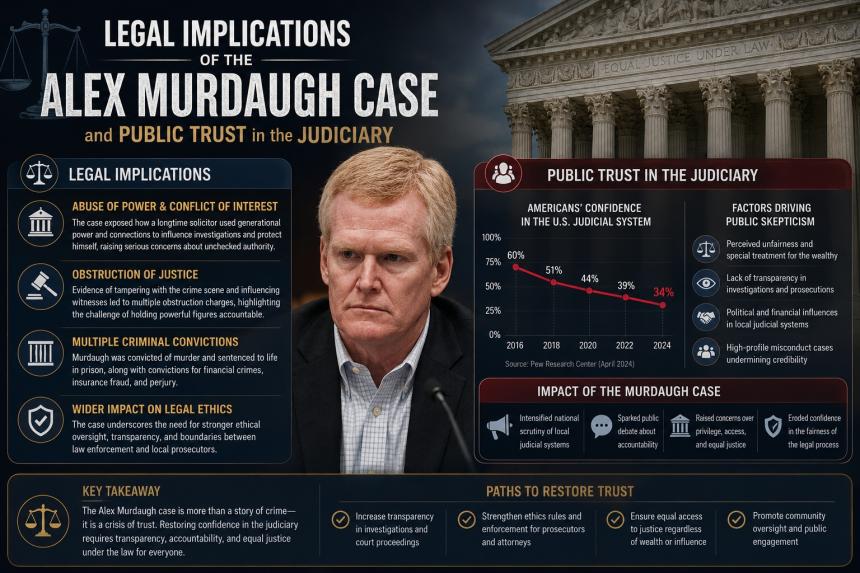

Legal implications of the Alex Murdaugh case and public trust in the judiciary
Legal implications of the Alex Murdaugh case and public trust in the judiciary
1. Introduction
In September 2021, Alex Murdaugh, a high-profile lawyer in South Carolina, was charged with the murders of his wife and son. Murdaugh eventually pleaded not guilty and was convicted in early 2023. The verdict attracted extraordinary public attention, and the case had unique features. Nonetheless, legal scholars have examined aspects of the prosecution, trial, and verdict in terms of their implications for public trust in the judiciary.
Public trust—the willingness of people to accept the courts’ actions as fair and procedurally just, and the emerging sense that, at least some of the time, the courts are genuinely holding the powerful accountable—has been in decline. This erosion is reflected in surveys conducted by the Pew Research Center and the National Center for State Courts, which indicate that people’s perceptions of the fairness of the courts, the absence of political influence, and their willingness to hold the powerful accountable are deteriorating. Trust in the courts is, of course, fragile. It can also be rebuilt when institutions acknowledge failures, support the candid expression of discontent, act in measured response to isolated cases of insiders’ or outsiders’ misconduct, and provide people with a better understanding of the role that courts play in society.
2. Overview of the Murdaugh case
Alex Murdaugh acted as his wife Maggie and son Paul were murdered, but he was only convicted of killing Paul. Other potential charges against Murdaugh were set aside and may be resurrected later. Those proceedings can traverse without disturbing the elements of murder needed for the convictions already obtained; questions have arisen about whether a judge may except one count from the waiver of double jeopardy.
The case blew up on social media, among cable channels, tabloids, and small-publishing houses. Perceptions of mistrials and of a trial not being allowed to be a mistrial were most often presented through a different lens, but the lattice nevertheless formed. The chances of a sober discussion of it reflected in credibility affecting not only media aversions in like, but also journalism’s inherent superiority that offered the elevation of problems of capacity and of addressing concerns rising with an interest to well beyond positions taken hurting audience interests as much as those at whose expense journalism again made an ass of media. The original postulation took up notions of crime reporters and the introduction of benchmarks into a systemic response only indirectly focused upon judicial conduct. It explored perceptions of unfairness as a determinant of audience trust in courts and of the consequent call to undertake the risk of reform for the sake of the risk of loss of continued confidence.
3. Legal implications for the judiciary
The Murdaugh affair raises several legal concerns for South Carolina's judiciary. First, the absence of appropriately rigorous disciplinary oversight allowed the prosecution to pursue a strategy that contravenes bedrock norms of fair trial practice: specifically, the Canon of Ethics that demands dispassion and reserving arguments for the jury. Second, the defense team succeeded in shaping the trial narrative by making unchallenged assertions that undermined the prosecution’s claim of double jeopardy; many South Carolinians appear to share that belief. Third, aspects of the case that could have contributed to public understanding of the judicial process instead posed a risk of eroding trust, notably the seeming frailty of the forensic evidence and the use of witnesses whose credibility was roundly undermined. Addressing these issues by making the justice system more open, any lessons learned from Murdaugh’s prosecution will not only promote public confidence but also minimize the risk of a successful appeal should other charges be pursued.
Well-established principles of prosecutorial conduct prohibit lawyers representing the State from making remarks that are intended to inflame the passions of the jury. Canon 3A(3) demands that “a Judge shall perform the duties of judicial office... without bias or prejudice." Yet trial judges have no inherent disciplinary authority over lawyers appearing before them; for speech at trial to be properly sanctioned, there must be a clear breach of a recognized rule or directive. In the aftermath of Murdaugh’s conviction, speculation about the possibility of double jeopardy was rife, and Murdaugh’s defense team shaped the narrative by making unchallenged assertions that the absence of such jeopardy represented a constitutional affront. Long-term public trust in the judicial system depends on high-profile cases being conducted to a standard that invites confidence in the system as a whole; where possible, hearings should be staged in a manner that provides clarity about the legal issues raised without the spectacle of breathless news as it breaks.
3.1. Prosecutorial conduct and double jeopardy concerns
Legal rules govern the conduct of all personnel involved in criminal proceedings. The trial and appellate prosecutors in the Murdaugh case made multiple allegedly improper decisions. Numerous examples can be cited to illustrate the problems. Serious issues arise from the investigation and prosecution of the Satterfield case. Having lost a wrongful death claim against Murdaugh, the family filed a second claim for the conversion of life insurance proceeds, which Murdaugh had failed to pay to the beneficiaries. He admitted to misappropriating the proceeds but sought to dismiss the new claim on grounds of double jeopardy. No one enjoys being a legal loser, but the cases do raise the issue of whether a jury may have been unduly biased, especially after hearing painful testimony about a living victim’s injuries. Even worse, he has made the same argument in a third and fourth prosecution as well.
Remedies for these bases of appeal are best drawn from transparent discussions by qualified specialists. The ideal remedy may not even be within the power of the appellate courts. The existing rules requiring commencement of Virginia’s proceedings within a defined time frame are a good example of proper internal self-regulation, giving the general public transparent forewarning as to the prohibition on excessive delays. Society is much better served by prosecutors who are personally held accountable when they pursue criminal charges that they know, on a reasonable basis, are either frivolous or, at least, empirically dubious, and who nevertheless limit their conduct to the strictest of criminal necessities. The appellate court’s ruling on the double jeopardy argument is equally crucial for law and order, as a criminal proceeding must invariably be the sole opportunity any human being is given to defend himself against the accusations presented therein. An appeal should therefore be a rare necessary evil.
3.2. Trial transparency and media influence
The importance of openness to scrutiny is widely recognized as a safeguard against the abuse of power. Judicial, prosecutorial, and investigative proceedings in this case were all open to the media and the public. While the absence of a gag order and the publicity surrounding the case raised questions about the fairness of the trial, there is a presumption that fair procedures lead to a fair outcome. As the US Supreme Court has stated, “the publicity that attends the trial of a sensational case is a matter of common and sad experience,” and it is neither feasible nor prudent to adopted an all-encompassing, preventative approach to pretrial publicity.”
The case highlighted the dangers associated with media coverage that caters to prurient interest, particularly when privileged information is used to weave stories that lack the safeguards of cross-examination and a standard of proof beyond reasonable doubt. Serious issues arise when the relentless pursuit of ratings leads to factually inaccurate and misleading “news” stories that sensationalize evidence and argue the merits of the case while the proceedings are on foot. The emergence of such coverage, combined with pretrial publicity that closely follows the throne, invites condemnation, exposes lawyers to ridicule, leads civil parties to abandon key claims, and diminishes the trust that underwrites the rule of law. Such coverage ultimately misleads the public, reducing the perceived legitimacy of the media and the judiciary alike.
3.3. Forensic and evidentiary standards
The Alex Murdaugh case serves as a reminder of critical legal concepts relevant to any judicial system. These concepts include the clearly defined expectations of prosecutors, the suitability of legal procedures and evidence management, and the careful consideration exercised when a legal proceeding begins under public scrutiny. Although a final ruling has yet to be delivered in the double-jeopardy motion filed in response to Alex Murdaugh's December 2022 indictment for the 2015 death of Steven Smith, the motion's argument highlights rules generally deemed foundational to the fair administration of justice. A failure to abide by these rules—whether perceived or real—undermines public trust in the judiciary.
None of this is to imply that Murdaugh is innocent of the crimes for which he has been convicted or is charged. The standard of proof necessary for conviction in a criminal proceeding is, however, intended to grapple with the consequences of factual errors. Greater care at each stage of the criminal process—from the gathering of evidence to its admission at trial—seeks to ensure that the truth is reached. Disorganization within the investigation, an absence of reliable evidence, or inadequacies related to the evidentiary foundation for an expert’s testimony risk invalidating the attempt to probe and test that truth. They thus ought to be taken seriously, at least in theory, even if such safeguards cannot guarantee the absence of wrongful accusations or convictions.
4. Impact on public trust
Transparency and accountability shape perceptions of judicial fairness. Cases involving misjudgment, bias, error, or perceived lack of fairness also increase distrust. When cases are described as lacking objectivity, public confidence declines. Conversely, perceived violations of constitutional rights, such as excessive sentence severity, usually do not have a major impact on public confidence in the judiciary.
The effect of a ruling on court confidence largely depends on the perceived fairness of the process. There is evidence that these steps lead to a decline in public confidence: as the number of cases involving judicial bias, systemic errors, and lack of transparency increases, confidence in the judiciary declines in tandem. Conversely, increased transparency restores confidence. The perceived quality of prosecutions is also relevant: recent analysis of survey data from forty-one countries shows that people are more supportive of courts that are seen to act professionally, impartially, and without excess.
The risk of cases having a negative impact on public confidence in the judiciary is also greater when they relate to an emotional aspect for a part of society, such as incidents of violence against the LGBTQ+ community or cases of police violence. Erosion of trust in the courts and injustice is considered one of the causes of the rise of the populist movement, which in turn fuels media narratives that promote the notion of judicial corruption: under this framework, people justified registering administrative misdemeanors against a former president, considering it a proper move to seek judicial accountability. Driver of confidence erosion in the judiciary and, consequently, the rise of populism is a sensationalist press that emphasizes corruption cases.
4.1. Perceptions of fairness and accountability
Research establishes that public confidence in courts declines following cases thought to be poorly handled or biased. Notably, perceptions of an unfair trial can induce significant drops in trust. There is also evidence that scrutiny exercised through open trials and courts, as well as a belief that government institutions act transparently, restores public confidence. The presence of measures that enhance accountability, such as prosecutorial investigations in corruption cases, as well as the periodic lapsing of prosecutorial immunity and their reinstatement by elected officials, have a similar effect on public trust.
Together, these findings suggest that trust in the judiciary can be undermined by cases that seem especially marked by error, bias, or a lack of transparency. They also indicate that measures designed to rebuild confidence, such as transparency-enhancing reforms or the imposition of limits or controls on prosecutorial discretion, can help to restore trust.
4.2. Erosion and rebuilding of confidence in courts
Public trust in the fairness and integrity of the courts relies on perceptions that judges and jurors are free of bias, and also that mistakes are identified and corrected. Cases perceived to feature bias that favored a defendant or bias against a defendant have been linked to drops in trust. Public skepticism about the conduct of legal professionals can resonate with communities long after the specific allegations become stale. The uproar surrounding the judiciary's handling of the high-profile Murdaugh case provides a case study for understanding the risk of reputational erosion and possible paths to restoring confidence.
Even if the justice system treats the accusations against Murdaugh, the scion of a prominent family in low-country South Carolina, as an isolated aberration, the news that they exist and that for years they fell under the radar of both the regional and national media inevitably trigger concern. The case illustrates how a poorly managed legal response to powerful people and painful local tragedy can send community trust in the courts into a tailspin. The fact that the erosion flowed from the actions of prosecutors and law enforcement is particularly germane at a time when many communities are wrestling with perceptions of political bias at play in judicial and prosecutorial decision-making. Restoring public confidence is best achieved through slow and steady measures rather than crashing reforms that risk overreaching and losing credibility—measured steps, in other words, that slowly but surely steer the judiciary into clearer waters.
4.3. Role of media and information access
Trust in the judiciary is tied to perceptions of fairness, impartiality, and accountability. High-profile cases that raise questions about bias or errors often result in lower levels of trust. Transparency helps to foster a sense of fairness, and how legal failures are perceived plays a crucial role in defining public opinion. The media play a key role in either strengthening or undermining trust. Reporting needs to be accurate, balanced, and avoid sensationalism. Moreover, unfettered access to court documents is necessary for journalists and the public to understand and assess what is happening in the courts.
The close involvement of media and the public in the Murdaugh case both contributed to and undermined the sense of public trust in the judicial system. On the one hand, thorough reporting meant that the actions of law enforcement were subject to intense scrutiny, which helped to maintain a level of accountability. On the other hand, the resulting media frenzy—whose product was at times colossally irresponsible—significantly detracted from the perception that the trial was being run fairly. Real-time reporting of the proceedings kept the public up to date but deprived the jury of an important shield against outside influence. Finally, the sheer volume of depositions and disclosures in a case of this nature demands an equally ferocious appetite for public access to court documents and materials. In cases where the media fall short of these standards, open access to the records remains vital.
5. Reforms and safeguards
Public trust in the judiciary requires transparency, rigorous training for judges, lawyers, and prosecutors, and engagement with ordinary citizens.
Measures to promote transparency include inherently open hearings, prompt disclosure of documents to the media and the public, and clear guidelines for access. Rules for public disclosure need not focus on their potential impact on decision-making, since the objective is to strengthen public confidence rather than judicial outcomes. What matters is that courts remain systematically and readily accountable to the community whose confidence they seek. Specifying a body or combination of bodies responsible for monitoring and implementing transparency measures will help ensure credibility.
Reinforcing public trust in the legal system requires actions beyond mere transparency. Judges, lawyers, and prosecutors wield considerable power over individuals and their reputations. Legal training should include a focus on the ethical and moral dimensions inherent in the profession, supplemented by continued professional development and education on personal biases. Judges’ decisions can have an important influence on community perceptions of the system’s integrity or impartiality.
Promoting public confidence also requires a better understanding of the legal system and its processes. Courts should offer community engagement programs where people feel they can ask questions about the justice system without being dismissed. Jurisdictions should consider the value of law days, programs designed to discuss legal issues or changes with members of the community, and the translation or simplification of highly technical material or forms into plain language, making them more accessible.
5.1. Transparency measures
Open hearings at all stages should be the norm, including multijurisdictional considerations. Disclosure of government and court documents should occur as soon as is consistent with investigations and court processes. Clear rules should specify which remaining documents will be publicly accessible prior to judgements or verdicts and who is responsible for ensuring access. This discretion ought to rest with the Information Officer in many circumstances, without requiring legal counsel approval if public communication would not contravene prohibitions on disseminating information issued under established guidelines. Providing and publicly identifying such authorisations ought to be a standard function for the Information Officer, who should consult the trial judge if in doubt or in politically sensitive cases.
Many factors, at least some of them controllable by the media, can influence perceptions of fairness, including speculation about the motivations of those involved in significant cases. Sensationalised coverage of high-profile cases—especially those involving sex offenders, family violence, or killings—can subconsciously condition views of fairness, with repeated assertions of bias producing an aura of mistrust. Reporting based on mere rumour, that fails to present both sides, connects to loss of confidence in judicial independence, and the extent to which judges deny media applications that would undermine fairness ratings.
5.2. Training and ethics for legal professionals
Legal professionals play a critical role in building public confidence, yet courts around the world often suffer from an erosion of public trust. Educational and training programs for judges, prosecutors, and defense attorneys should devote substantial attention to the problem of public confidence in the integrity of justice. These programs should examine how professional actions impact public perception and legitimacy. Addressing bias and diminishing public trust should be recurrent themes. The alleged behavior of the prosecutors in this case should serve as an object lesson for other law