
A Simple Comparative Analysis of the Yankees vs Mets Rivalry in Major League Baseball
A Simple Comparative Analysis of the Yankees vs Mets Rivalry in Major League Baseball
1. Introduction
A Simple Comparative Analysis of the Yankees vs Mets Rivalry in Major League Baseball
Major League Baseball's New York Yankees–New York Mets rivalry is intense and historic. It features many famous moments and crown-jewel games as the teams strive for supremacy in New York City. But it differs in scope and intensity from other MLB rivalries—especially the Yankees vs Boston Red Sox and Chicago Cubs vs St. Louis Cardinals rivalries—due to distinct regional, chronological, economic, and expansion factors. The Yankees’ sustained on-field success has also diminished the rivalry's competitive edge and cultural relevance.
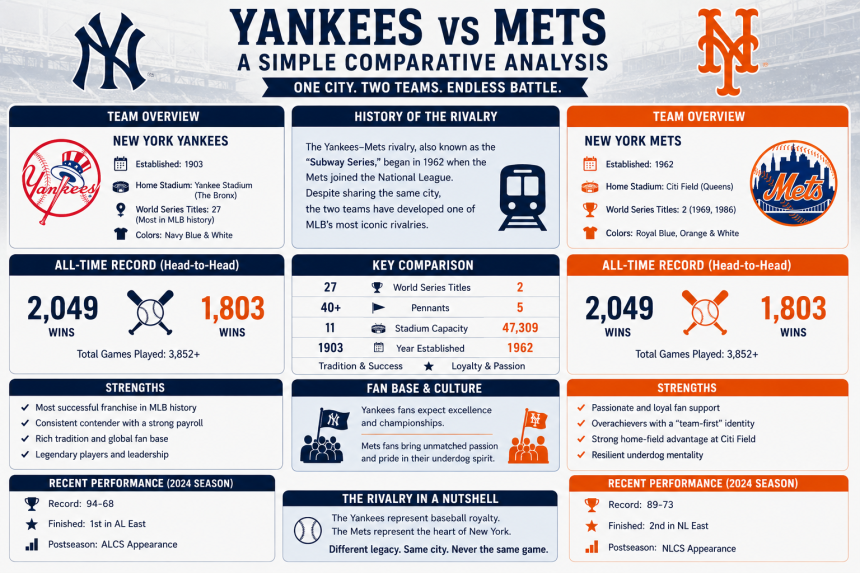
The rivalry began when the Mets first played the Yankees in 1963 and has endured in different forms ever since. Recent ownership and management changes for both teams—including the hiring of President Sandy Alderson by the Mets before the 2011 season and the arrival of Aaron Boone as Yankees manager ahead of the 2018 season—had major implications for competition within the American League (AL) East, for the National League (NL) East, and thus for the Yankees–Mets rivalry. The Yankees have won 13 of the past 20 games between the teams, but the Mets have had their share of recent success as well, including a 4–2 edge in their head-to-head meetings during the 2022 season.
2. History of the Rivalry
The New York Yankees and New York Mets first met in 1997. Despite being Major League Baseball's Subway Series, the sheer number of head-to-head matchups between these foes over the years has forged one of the great rivalries in sports. Nevertheless, it is not on par with the Boston Red Sox rivalry or with the Los Angeles Dodgers rivalry. The on-field events, attendance records, fan culture and media buzz have yet to match those of the biggest rivalries in MLB.
Unlike the Yankees, who have been a powerhouse club stretching all the way back to 1921, the Mets until recently were a punchline of a team with four pennants and just two titles in 61 years of existence. In the earliest years of the modern Subway Series, the Yankees played down to their supposedly inferior “little brothers.” The Mets took six of the first nine matchups, an embarrassing statistic at the time for the more storied of the two franchises, leading one Yankees radio announcer to declare: “Game over! We lost!” The Yankees' first victory, a 4-2 decision on July 23, 1997, was one of those letdowns. It was so much of a letdown that one Yankees radio announcer simply said, “Game over! We lost!”
3. Key Teams and Moments
More than two dozen teams have met in the 26 seasons of the Subway Series, but just four angles—the Yankees, Mets, playoff encounters, and epic comebacks—distinctly shape the rivalry. The latter primarily involve the Yankees’ victories, including 2000’s tantalizing tale of forecast failure made gloriously unreal. Yet they aren’t merely a fair-weather phenomenon— a special vibrancy defines their plays and players no matter the standings.
Sports Illustrated christened 1997’s May 7 encounter “the biggest act in baseball history” on the strength of its ticket prices alone, labeled “adult” seats just beyond center field selling for a gawdy $150 each and scalpers reportedly accommodating crazed fans with chants of “606” (the prices of items behind home plate) that drew offers exceeding $10,000. Hosts in the Bronx again boasted major advantages, including a pennant leader piloted by Joe Torre, who’d pass the original record price of 1986 World Series tickets, for the first time addressing the media seated in a ring of fire extinguishers.
Even that was only foreplay for the two-day gathering of “541,” a million percentages in understatement, prior to mid-July’s additional epic. The postseason, of course, brings heightened emotion and intensity to all rivalries. Yankees-Mets fathered some of baseball’s biggest moments, both indelibly ecstatic—for the Bombers— and break-the-TV seconds. In 1999 and 2000, playoffs for the first time galvanized non-playoff regular-season facing, first cemented by Roger Clemens’ scintillating July 8, 1999, evocation of Mariah Carey pre-. Certainly, the intense start-and-stop-with-the-racquet-nicety makes them much more exciting for all and identifiable for bets since anything anyone physically alive—except for Luis Sojo—could never imagine then believe then finally just feel inner core doing.
4. Fan Culture and Media
The Yankees-Mets rivalry is fueled by the passion of fans and the intensity of covering media. When the teams play, ticket prices soar, and crowds pack the stadiums—even on the road—as fans travel to take part in the rivalry. Unique traditions such as the “Yankees Suck” chant and the presence of a large group of Mets fans at Yankee Stadium have become defining elements of the fan culture. Reporters strive to capture the heightened emotions, and broadcast networks dedicate resources to ensure the games receive ample attention.
A closer look at the attendance figures in the history of Yankees-Mets games underscores not only the desire of fans to witness the rivalry, but also the willingness of the cities and networks behind the two teams to help generate those matches. Besides being ranked first, fourth, sixth, eighth, and tenth in attendance figures, the games have seen large crowds on the away side of the rivalry. In October 2015, a crowd of 6,000 Mets fans at Yankee Stadium for a September game is more akin to a postseason match than a regular-season matchup for the visiting team.
5. On-Field Impact
The rivalry impacts what happens on the field in many ways. Game preparations often include discussions of how to pitch against the other side’s lineup. Star pitchers might be scheduled to pitch against one another. When the manager is considering a lineup or pinch-hitting choice in a close game, he might prefer the player who is better at hitting under pressure or against left-handers. A player who has had a terrible season might suddenly do well, turning the game into a local spectacle. All these factors subtly affect how teams approach the rivalry, shaping not only the games themselves but also the players involved in them.
Rivalry games can be major momentum shifts for teams, especially if a player was enjoying a great season and manages to fully live up to his potential for one or more of the games. Winning or losing an entire season’s worth of games in one day or one series alters the players’ outlook on their current year and possibly the next. Because of the huge crowds and high expectations from fans, rival teams often smell victory and can perform above their usual level. Such highs and lows can change the entire feeling in the clubhouse leading up to the next series and the chances of finishing the season strongly.
6. Economic and Geographic Factors
The Yankees and Mets are not just two Major League Baseball teams in New York City; their rivalry produces record attendance and economic spinoffs each season. Some of the greatest games and moments in New York City sports history have taken place within this rivalry, even without the ferocity of the Red Sox–Yankees rivalry. Spending and ticket prices, advertising revenue, local media, hotels, and the travel and hospitality industries all benefit from the battle for New York: Team New York, Yankees vs Mets. According to estimates by ESPN, ticket prices for this rivalry are among the highest in sports, regularly putting the cost of attending a game out of the reach of many fans. The Yankees and Mets play to full houses every time, but it is the allure of a prime rivalry matchup that generates the most traffic.
Most stores within a five-minute walk of either stadium run at a profit when the rival teams play each other because the price of rent is cheap, and the high volume of potential customers ensures profitability. Both teams enter the midtown Manhattan area on rival game days and saturate the market with anti-graffiti spray-painting. All the subway lines that run between the Bronx and Queens are packed when the Yankees and Mets are playing, and non-New York radio stations pay these local plays a premium to advertise during the games so they can reach their local markets. While travel is so frequent that a game remains a local play for Boston fans, who make up a very good percentage of all Red Sox games, the traditional rivalry between the Red Sox and the Yankees cannot heat things up like this.
7. Recent Trends
The most recent years have featured changing dynamics in the rivalry as the Mets have cycled through three different ownership groups and five managers since the end of the 2010 season, while the Yankees have relied on the core of a roster that spent large portions of the last decade anchored by star catcher Brian McCann, all-star shortstop Derek Jeter, and pitchers Mariano Rivera and Andy Pettitte. This blend of familiar Yankees and strugglers on the opposing side led to an unusual win-loss trend in Interleague play over the last decade, with the Yankees compiling a commanding 22-8 record since 2008, including 16-5 since 2011, and winning six consecutive matchups since as far back as the 2015 season. A few of these contests featured players of note representing the clubs, especially in a first-ever playoff meeting in 2000 that saw the Yankees sweep en route to a title and an additional recently notable meeting in 2022 when the Mets triumphed.
A pervasive sense of uncertainty clouded the more recent results leading into the 2023 regular season, with the Mets once again turning over ownership after a series of failures during the Wilpon Era before the arrival of Steve Cohen and his commitment to spending whatever it might take to get a winner in Queens. With the Yankees-Dodgers rivalry on the shelf while the Dodgers have turned over their roster and lost their dominance, attention could wisely focus on the recent history with the Mets hoping to carry more overall momentum into their annual matchups.
8. Comparison with Other Rivalries
This section compares the intensity and scale of the Yankees-Mets rivalry to other MLB rivalries; it highlights both similarities and differences in fan attitudes, media coverage, and the impact of their local market. The primary focus is how these factors differ from those surrounding the Red Sox, Cubs, and Dodgers.
Similarities and differences in rooting behavior, attitude, and media contact between the Mets-Yankees rivalry, North America's first true intra-city rivalry, and rivalries such as that between the Red Sox and Yankees. The New York Yankees-New York Mets is not the most intense rivalry in the Major Leagues, certainly not in terms of fan culture and local attitude. Even if the various media noise surrounding the weekend series tends to be louder than at other rival series, it is not necessarily that the rivalry itself is more relevant to the respective parties. Many fans, especially Yankees fans, can admit the Mets are a good team, a fact evidenced by the increase in support shown for the Mets in 2000 and 2005—one the Yankees could have started to embrace considering that they played in a different league. This cannot be said for the Red Sox rivalry, as both fan bases, and players too, thrive on hate. This was also why the Red Sox rivalry can never be so relevant that a Red Sox loss to the Yankees could help secure a few extra wins elsewhere; to a Red Sox fan avoiding a loss to the Yankees is always more important than winning the title. The complex dynamics of the different fan bases is what makes the Mets-Yankees rivalry special, and not just another typical war, where 'the other side' blocks 'our' ticket sales but adds depth to stadium attendances and health to the economy.
Even for the fans themselves, the intensity of the Mets–Yankees rivalry sizzles upon hitting the sport pages, but all other news channels cover it pretty much like any other game. A Mets–Yankees game simply cannot be sold as 'The Game' for either club in the same way as a Red Sox–Yankees game can. Nonetheless, that does not make it any less important. A team can win the World Series and have a metal plate stamped for it with a trademark gold-plate finish. It can invest to win the World Series. The Yankees are a rich franchise that rival teams can play against and joke about for their financial excess even while trying to steal a trade and landing a small fortune as a result. An entire fan culture can develop in anticipation of the series. But none of that reduces winning them. In that respect, their local fans are more like fans in Los Angeles, watching the most invisible Dodgers-Giants rivalry of the last two decades. Both clubs can make jokes about how they can never win the title, and how all the concentration goes to the other team. Yet, when they play in the 2000 World Series, it gives the 'Letters' match more cultural attention than any World Cup Final (since both peaks of sport come together for only the second time ever) while disappearing without a trace from the forefront of the 2005 culture. The Yankees–Mets rivalry is perhaps the biggest such example within the boundaries of sport.
9. Conclusion
New York’s Major League Baseball rivalry transcends sports. Dominated by the white-collar Yankees and blue-collar Mets, it features remarkable attendance figures, a passionate following, and media saturation rivaling the NBA Finals or World Series. Specific ticket prices, hotel bookings, and restaurant reservations appreciably soar. Unlike other rivalries, Yankees-Mets games influence players’ everyday lives and alter managerial strategies. Despite recent trends suggesting greater Mets success, evidence indicates the Yankees maintain the overall upper hand.
No rivalry compares in sheer presence. All reside within a thirty-mile radius of midtown Manhattan; the Yankees and Mets share the same local radio and television audience and are as close to each other as the Yankees are to the next-nearest team, in New Jersey. Home games occur only nine miles apart, an easy subway trip—especially since the number seven train stops at each stadium. The train makes every game a battle in the Bronx and a war in Queens, where a yellow-and-blue-clad Dutch army marches in and Occupies Section 140. For every Yankee fan saying, “Let’s go, Yankees,” ten Mets partisans answer, “Yankees suck.” For nearby broadcasters, it’s Yankees game seven every day.
Yet the rivalry’s character differs from others. Red Sox-Yankees clashes embody regional feeling; White Sox-Cubs encounters finish like a Flava Flav roast; Cub-Cardinal caps see more dads the kids haven’t spoken to in years. The Mets’ working-class origins produce more Brooklyn Dodger than Cubs rivalries with the Yankees, reflecting stadium ambience rather than farm systems or team colors. Moments like Keith Hernandez’s throat-slicing gesture toward the stands, Gary Carter’s imaginary laser beam during a rain delay in 1986, Santana’s no-hitter, and Met luster in the suburbs mark the clash less than Sanchez’s wheels or A-Rod’s dumb smile. Just as the Rogers Centre lacks an underground industrial community, the Rogers Centre lacks any underground-feeling rivalry with the Yankees; Terry Leach’s sideline became more like a honeymoon than Yankee Stadium. New York features inimitable transcendent snapshots, a thousand flashes illuminating a different fabric every other moment yet somehow still….