
A simple comparison of Real Madrid and Real Oviedo: history, rivals, and current performance
A simple comparison of Real Madrid and Real Oviedo: history, rivals, and current performance
1. Introduction
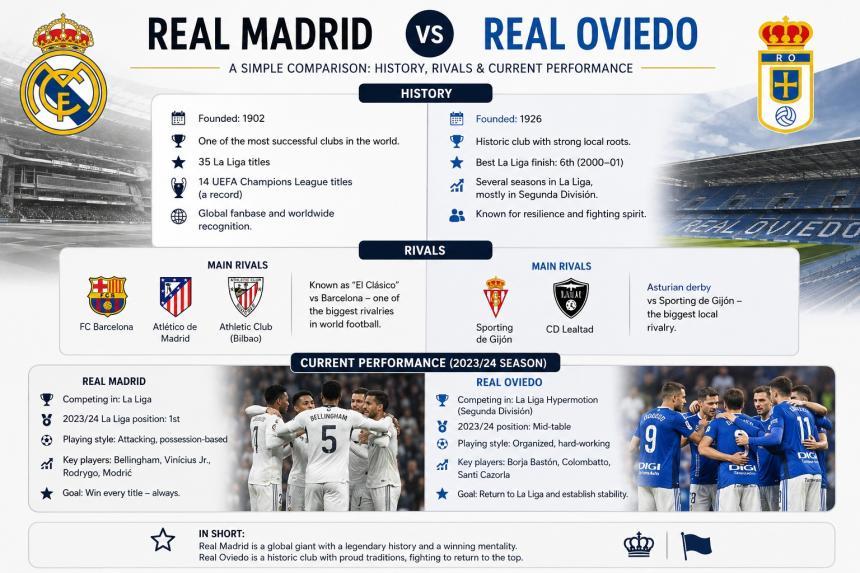
Real Madrid and Real Oviedo are two clubs with very disparate histories and statuses in the modern football ecosystem. Real Madrid is regarded as the most successful club in football history, while Real Oviedo has spent almost its entire existence in the top two divisions of Spanish football. However, an important share of the club's 113-year history has been between the lowest two divisions, which is also the case for the last two decades, in which Real Oviedo has been mostly a club of the Segunda Division.
A simple analysis of history, milestones, and recent performance suggests that a sporting rivalry exists between Real Madrid and Real Oviedo. Early direct meetings developed into a meaningful rivalry for Real Oviedo, "La Capital" team, which enjoyed a period of ascendance associated with Madrid players’ second team, CF Madrid, and later Real Madrid's B-team, Real Madrid Castilla and its player policies. Nowadays, the rivalry has faded following Real Oviedo's relegation to the lowest levels of Spanish football. Patterns in the most recent seasons suggest that Real Madrid continues to view Real Oviedo as one of its smaller rivals.
2. History of Real Madrid
Real Madrid Club de Fútbol was born on 6 March 1902 and has inhabited various cities, divisions, and leagues. The club is commonly associated with the breath-taking periods of the late 1950s and early 1960s, yet many may not know of its historic domestic decline in support and performance. Others may recall the wild 1980s, when Madrid’s refusal to conform to the prevailing tactical orthodoxy saw the club both dominate La Liga and claim Europe’s top prize five times. Most acquainted with football history will know of the disastrous years between 2000 and 2010, when it somehow became the richest club in the world yet couldn’t finish above seventh in La Liga.
Real Madrid is synonymous with European glory. No other club has so many Champions League titles (14), nor has any other sport club achieved more international success than Madrid’s 30 trophies with FIFA’s global governing body. Fittingly, the club’s biggest moments have often taken place against the continent’s strongest teams. The matches sworn never to be repeated or the ties in which all fans of the sport—those supporting both clubs and those neutral—hoped for a different outcome are all there to relive in the pages of the archive. They represent triumph, pain, drama, passion, relief, jubilation, and unsurpassed enjoyment. But they do not tell the full story of a club, nor of its league performances. They have, however, shaped expectations: simply qualifying for the group stage is not good enough; failing to reach a final is.
A simple summary of Real Madrid’s fortunes since the club’s founding highlights the major eras much more clearly. The first Galáctico team conquered everything in the late 1950s and early 1960s, the club then endured a trophy drought not witnessed since the 1940s. The club entered an 18-year period without winning La Liga until Luis Molowny assumed the helm as manager of a side featuring the great Alfredo Di Stéfano and saw Madrid crowned champions crowned La Liga three consecutive times. The Galáctico movement resumed, with a team famous for winning the league often dubbed “the best team in history”: approximately half the team were important members of the core national team.
3. History of Real Oviedo
Real Oviedo was founded in 1926, arising from the merger of two minor teams. In contrast to Real Madrid, whose status was assured by political connections, Real Oviedo gained Royal patronage when Alfonso XIII was crowned King of Spain in 1902. Sadly, Oviedo has seldom brought pride to its supporters. Since 1993, the team has been unable to secure a place in Primera División; rumor suggests that the first share has become akin to an albatross, a burdensome obligation, rather than a coveted prize. Nevertheless, one cannot disregard the standout highlights and matches that remain memorialized in the annals of the blue and whites.
One major terror inflicted on Real Madrid’s players is etched in history after they lost 1–6 at El Molinón in 1993. The tackle had been truly horrendous, enacting vengeance for a sickening challenge on Taribo West in the first match. For almost a decade, Real Oviedo performed above expectations, battling against the forces that test teams from Asturias and the north of Spain: geography, weather, and time. The early meetings were rather one-sided, with Madrid winning almost all matches. One exception came at El Molinón on 31 January 1937, when Madrid were expelled from the league after refusing to play a scheduled game despite Valencia federation granting them permission to forfeit the game. They therefore lost by default, leaving the local team with a more pleasant memory. That match became even more memorable for Real Madrid fans as they pulled off their only Spanish cup title in only that year.
4. Early Rivalry and Key Clashes
The first Real Madrid–Real Oviedo matches occurred between 1932 and 1935 in La Liga and Copa del Rey tournaments. All league matches were won by Real Madrid, the first 9–1 in 1932, the second 2–0, and the third 4–0. In Copa del Rey encounters, the balance was much closer: Madrid advanced on an aggregate score of only 2–1 over the two matches played. However, the rivalry had a more important moment during the 1936 Copa del Generalísimo. Madrid, the defending champions, were eliminated by Oviedo in the quarter-finals. As Oviedo coach José María Fernández opened the door to Madrid, “It [the elimination] is a historic event for Oviedo, and I’m convinced that Madrid will have it hard until the final whistle.” Madrid had a great team, with legendary Alfredo Di Stefano, but these early clashes are seized by La Liga for Oviedo.
The two clubs would not meet again until 1962 when Madrid won the 5–1. The two clubs would enter a period in which they would only rarely meet. In 1975, Madrid won again 4–1 at goal difference level. On 26 July 1984, Sportman Cl finished season in seventh of the league, eight above relegation and 18 points behind champions Real Madrid. The match would be Real Oviedo captain Cholo Sotelo’s last match before retirement. He is Oviedo’s captain in the club’s Hall of Fame. Madrid would finish the season in seventh-place. On 4 February 2001, in an injury-time winner, Míchel Salgado saved Madrid from a draw. The three matches would enter a final stretch of captivating, edge-of-the-seat encounters between two teams that could not keep relying on the top. In 2021, Oviedo kept close in a 2–0 home defeat; Madrid relied on Chukwueze’s pace on the counter against Álex Alegría’s red card; Austria grabbed a draw with Kostić’s second goal. The last ten seasons had failed to throw many headline stories Madrid’s way.
5. Modern Rivalry and Matches
Real Madrid's Cruyffian-style resurgence and dominance under Fabio Capello led to a period of protracted but one-sided encounters in the early 2000s. However, as Real Oviedo slipped into the Spanish Second Division, the trend shifted. Over a period of seven seasons between 2001 and 2008, the clubs did not meet. With Real Madrid frequently coming up against Barcelona's ageing, less potent, yet still more than able attacking guile, the latter half of the decade saw an initial dip in the Spanish capital's fortunes. Between 2009 and 2012, the club won the league three times—but only was able to win one league title against a Barcelona side playing without Pep Guardiola. At the end of the issue, Barcelona returned to their course with the great Lionel Messi, Pep Guardiola, Xavi, Andrés Iniesta, and others.
From 2012 onwards, Madrid has found itself more and more dominated by its Catalan rivals—prone to the same tactical traps which allowed Oviedo to exploit a weakened and exhaustively pressured and vulnerable defence in the second-division game of 2022-23. The Oviedo club had been on the very brink of complete closure, much like the old 'terrorist-style' club Atletico de Madrid, amidst its own tax problems, before being resurrected by some supporters; yet it was still able to clinch a surprise victory at the late-spring meeting. Perhaps for this very reason, the many disparate supporting factions across the globe are increasingly forming their own niche clubs, racing ahead in those local leagues and gaining expertise at speed, whilst the so-called 'big' clubs tend simply to age.
6. Current Performance: Recent Seasons
Recent comparative performance examines two specific seasons: 2022/23 for Real Madrid and 2021/22 for Real Oviedo. Madrid finished second in La Liga, another Copa del Rey run ended in the quarter-finals, but a strong Champions League group stage led to a home quarter-final on the road to the final for a 15th win. Oviedo ended the prior championship in 18th, two points clear of relegation. A narrow run through the second half of the current 22/23 Palacio de los Deportes and a new focus on season tickets early in the 23/24 season in the second half is hoped to draw support for the fledgling project.
The two clubs’ squads differ widely. A youthful Madrid core continues under Ancelotti, leading to a welcoming of coach Raúl back into the fold; Vinícius leads the league in individual formations and tactical setups. Focus for Oviedo has been on the back: expected injuries to key defenders led to the three tightest central roles being filled by four players, requiring extensive flexibility from other positions. The return of a fit Almeida Díaz threatens García but has also eased the role of understudy. Montejo, positioned to the right of Ángulo, and González, at three have periodically had to adjust to accommodate longer spells from Moreno.
7. Player and Management Impact
Few aspects influence a club's performance in a season as directly as its players and managers. All other things being equal, the presence of world-class players or intelligent managers should lead to a higher points tally. For Real Oviedo, the test of this logic in recent seasons is inconclusive. The absence of José Ángel Ziganda in the 2022–23 campaign, sacked mid-season, did not help the club. The same is true for the departure of Daniel Pastor, one of Oviedo's best players, sidelined for the season with an injury. Taking those examples together, one could argue that giving the reins to a seasoned manager such as José Anquela should yield dividends. The club's latest trajectory does not support this view, however, as the manager—by far the coach with the most poor beginnings—has not been able to put together a competitive squad.
Conversely, Real Madrid possesses a squad with no glaring weaknesses. Achieving balance is not merely a matter of weight—in this case, mediocrity—on both sides, rather the group must blend and gel to produce results. In this, Real Madrid benefits from Carlo Ancelotti's ability to reconcile minds susceptible to clash due to cultural differences and different expectations from their profession. His own past experience, having managed AC Milan at the height of their power, and inequalities elsewhere in the club's playing squad have allowed him to ease the pressure on the players, particularly when nothing less than victory is considered sufficiency.
8. Financial and Fan Support Differences
Converging on their contrasting circumstances, massive differences become evident when contrasting the financial revenues of the teams, as well as the changes to the remaining support. Real Madrid has by far the largest budget and turnover worldwide. Its revenues from the sale of sponsors and TV rights are measured in hundreds of millions of euros. This means that the players and staff can be paid much higher amounts than their competitors; no one would doubt that they are the best paid in the world. Moreover, they have a sponsor on their shirt, something that Real Oviedo would dream of having in any of the main leagues.
The percentage of fans that Real Oviedo now has compared to Real Madrid is smaller than when the rivalry began. Madrid’s home games are all sold out, with investments in the stadium giving it a different approach every year. There are also easily identifiable fans all over the world, and when Madrid visits any country, hundreds of Madridistas flock to the stadium. Oviedo’s fan base is much lower in number. The amount of tourists visiting the city during Easter and summer is huge; however, the majority have their football commitments and visits to local teams already decided. Even a team like Ajax can counteract local tourism with football tourism. Real Oviedo is limited to the support of local fans or those who have moved to other cities in Spain. Most matches are played in half-empty stadiums, and the resources available for the club also depend on this source.
9. Tactical Trends in Both Teams
Real Madrid and Real Oviedo have much in common in terms of their tactical approach, particularly in matches against teams within the same category. However, stark differences surface when facing Clubs from the other category—especially the perennial crosstown rival.
Against similar-quality opposition, both squads intend to have lengthy possession of the ball, generating chances through risky plays and a high defensive line. In these situations, Real Madrid appears slightly more daring on the ball, taking greater risks when building from the back. This sometimes leads to individual errors leading to opponents’ open-net chances, which isn’t very typical of teams of this caliber. On the other hand, Real Oviedo is more cautious in rotation and buildup play but slightly more aggressive when pressing opponents, anticipating lose balls high up the pitch with quick counterattacks. Odds of scoring from dangerous plays remain relatively low in recent encounters for both squads.
In contrasted-category duels, Real Madrid usually possesses the ball and maintains a defensive line higher than the rivals, often catching them offside. Against inferior teams, Madrid tends to hold the ball perfectly across the entire pitch—wasting long spells in these inferior zones—sometimes allowing rivals an overload on opposite flanks. Oviedo aims to hold the defensive coastal line as deep as possible, postponing actual difficult defending duties as much as possible and keeping the defensive line stretched—but not spreading too much—prioritizing compactness over aggressiveness. The trends in all encountered matches remain mostly unaffected by the presence of Luciano or José Luis Martín as head coach.
10. Challenges and Opportunities for Real Oviedo
Current performance of Real Oviedo (2021/2022 and 2022/2023 seasons)
Current performance has been more uncertain. In the 2021-22 season, the team finished 12th in the second tier with very little fanfare, while the early 2022-23 league season saw them flounder after 12 matches – standing at 19th – before switching head coaches. In the Copa del Rey, Real Madrid scored a big victory against a struggling lower division team. Early in 2022/2023, the club announced that with the help of a commercial partner, it had plans to build a sports complex in the Asturias region, including an academy for the first team and a fielding center for the academy. In late 2022, Oviedo launched a communication strategy aimed at enhancing the marketability of the club within the wider Spanish sphere and increasing potential revenues for the club to be used in on-pitch battles.
Although the team has been competing in Spain’s second division in recent years, it has been a long time since players from the academy have made an impact at first-team level, and very few players have made their mark in top-flight football. The board may want to explore whether a return to La Liga can offer an opportunity for the football development strategy to produce results, and if creating a small network of other clubs – in Spain and beyond – can at least partly alleviate the current revenue disparity with the team in white.
11. Conclusion
The major aim of this comparison was to clarify how Real Madrid and Real Oviedo differ from each other in terms of history, rivalry, and current performance. To achieve this goal, three key questions were considered: 1) How has the early rivalry developed historically? 2) How has that rivalry manifested in more recent matches? 3) A qualitative judgment of the two clubs’ current performance level, particularly in relation to their last two seasons.
Answering these questions highlights the contrasting fates of both clubs and reveals fundamental rifts in their rivalries and in the dynamics of those match-ups, grounded in key differences between their levels of revenue generation. For Real Madrid, the biggest side in Spain by margin, revenues have continued to balloon and commercial success has been converted into sporting glory through a talented coaching staff. Real Oviedo are currently punching at Championship level and seeking ways to assert themselves in the market, not only because promotion to La Liga is terribly challenging but also because such a significant step would have a powerful realigning effect on their financial base.