
Rivalry between Pachuca and Pumas in Mexican football
Rivalry between Pachuca and Pumas in Mexican football
1. Introduction to the rivalry
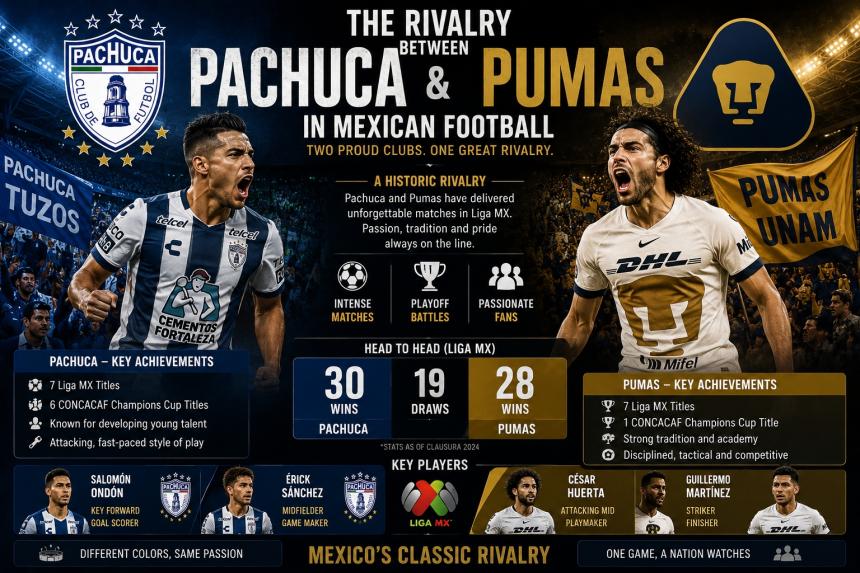
The Pachuca vs. Pumas rivalry showcases a classic football clash between Club de Fútbol Pachuca and Universidad Nacional. Based in Pachuca and Mexico City, respectively, both compete in Liga MX, the top tier of Mexican football. Both clubs have won prestigious national and international titles and are renowned for their youth academies, which have produced some of Mexico's greatest footballers. However, their youth facilities often act as a springboard for Pumas' Interliga, seeing their most prominent players transfer to the capital. Therefore, the rivalry extends beyond trophies; regional supremacy and, increasingly, success at youth level make every Clásico Tuzo-an equally important match for both clubs.
The Pachuca-Pumas rivalry is often defined within Mexican football for the principal tournament titles and the desire to be considered the best football team in Mexico, as well as being the club with the best improvement in the last decade. The matches are met with special attention and rivalry not only from the fans who have attended both clubs but also from the general Mexican sports press, which attends and follows this meeting closely. These games are important because the Pachuca and Universidad Nacional teams are among the three highest-ranked clubs in the last decade in Liga MX scoring and professional soccer trophies, in addition to the fact that the last Mexican players to be coached by Europe were Cuauhtémoc Blanco and Hugo Sánchez, who were trained in Pachuca and UNAM, although they arrived at their respective clubs for the late bus, their first teammates were part of the Pachuca base team, which was marked a great sign of united football.
2. History and origins
The rivalry began in August 1957, when Pachuca faced Pumas in Pachuca. The hosts won 2–0 in the third game of the 1957–58 Liga Mayor season, and the events surrounding the match were significant. Four years earlier, the recently incorporated Universidad Nacional club had been promoted to the top tier of Mexican football. Pachuca, on the other hand, was taking part in the top division with an experienced team made up of Mexican players and some foreign figures.
The early meetings were somewhat unilateral. In the first four matches of the rivalry, Pachuca won three and drew one. One of those meetings left an important mark on the rivalry. On April 8, 1961, the colleges secured their first point in the series. Despite the scoreless draw, the consequence of that match served as an omen. It marked the beginning of a series of five victories for Pumas over Pachuca. The debut of the Universidad Nacional team at the Estadio Azteca generated great expectations among supporters. The Pachuca fans did not want to be outdone and filled the stadium in a true rivalry match. When Pachuca was playing some of the best football in the league, the victory of Pumas did not surprise the fans.
In the early years, when Hugo Sánchez led Pumas, more lighthearted dramas were also seen surrounding the meetings. Pachuca was coached by Enrique Mena and relied on local players. Pumas had the best youths and the great offensive prodigy in national football, Hugo Sánchez. The matches had become symbolic after Pumas took the inverted role in a few matches. Pachuca was challenging for the title at the top of the table, while Pumas were sinking in the bottom positions. The victory of Pumas would mean bitterly defending the bottom places.
3. Key matches and memorable moments
Throughout the years, the two teams have clashed on numerous occasions, each match holding a different significance and importance. Several key matches and memorable moments stand out from their meetings, as when chance conversions defined the encounter, when a great goal marked a turning moment, when one lost a final after finishing the regular stage on top, or when a thorough dominance extended beyond field performance, but something not always on the field has gripped the players behind the goals categorically influencing players’ performances: Pachuca is the second most common team in Luis García Postigo’s career, and the most fruitful one; both teams are synonymous with Carlos Salcido’s glorious childhood story; the exaltation persists—on the pitch, during training, and even in the box—.
While remembered only for their cup knockout eliminations, their contests have also featured championship and cup finals in which no penalty shoot out took place. Just as the cup competition produced some early and more encounters yet to come, their history saw unique matches marked by important cross-club players, disproportionate TV ratings, or public protests linked to external factors. Media chronicle, legend, or card studies learnt and retold over and over again describe an apparently clear progression on and off the pitch through the years.
4. Rivalry impact on players and teams
The Pachuca-Pumas rivalry has profound effects on players and teams. For many players, these clashes are the most anticipated games of the season. A poor performance can stain a player's tenure, and always wearing the Pumas jersey creates an additional pressure. For others, it can also be a chance to shine and prove themselves. Some players grew up in the Pachuca or Pumas academies. Many Pumas fans remember Lauro Sánches's performances with Pachuca because he came through the Pumas youth ranks. These players usually feel they have a special motivation. Whether or not they perform well, they are inevitably judged, since failures or successes in these crucial games can determine their football career.
The team’s history has marked Pachuca more than Pumas. Pumas have suffered poor crosses, but Pachuca is the team that has suffered the most. Pumas tends to make important transfers for these games. Injuries and suspensions are also factors: when Pumas loses an important player for the matches against Pachuca, it gets the worst of it. Players that go from Pachuca to Pumas maintain the tradition of performing very well, while the contrary tends to bring average performances. Frankly, it’s Pumas with the upper hand. The manager factor has also been important. Managers with ties that are strong enough to care face less pressure than those without links. Players from abroad who are recognized in Mexico also feel this game carefully. They usually want to be at their best shape or include this game as a main objective of that season. Another important factor is the influence within the squad. Pachuca’s squad has had leaders who gave confidence to the youngsters during crucial games, while Pumas has had its own group of leaders.
5. Fans and culture surrounding the rivalry
Fans of Pachuca and Pumas do not need special motivation to watch a match between the two clubs. Noone has need to look for Pumas or Pachuca fans for their support. These colors are taken to the rival stadium to provoke the fans of an old rival that is close, because the condition of the fans of both institutions feel hatred towards the club colors blue and gold or white. There are many things that can not be missing, in the stands of the Pachuca and Pumas matches, from the ghosts of the fans of Pumas who were transferred from Mexico City to Tonatico or Toluca, and other symbolic things like the infamous La Huerta that continues as it is and that at one point forgot the myth that Pumas were Pablo and Marín de Pachuca.
The fans of Pachuca do not spy on rivals from Lima. All the games against Pachuca run under carnival, being that for the Peruvians that day there are no friends. One puertorican was sacrificed in a match at the Hidalgo Stadium when Pachuca won 4-9. The fans of the Pumas or Huichol dogs do not seem to disguise the sibaritas of the Pachuca matches because the matches are clear and colorful like when Pachuca had the bad habit of beating Cruz Azuí. The Huichol fans are the only ones who take friends to Pachuca out of the city to hear hopeless chants from the Huichol dogs.
6. Short-term and long-term effects on Mexican football
The rivalry has produced effects beyond its parties and its direct participants. The two clubs established Czech regimes in Mexico. Taken together, their successes, player strategies, formative styles, and physical elegance made them attractive for youth development and a valuable source of talented players. The growing youth depth, in turn, coincided with more winners establishing themselves in the league, thanks to an upward cycle for Mexican football in the early years of the new millennium, leading to higher television ratings and attracting attractive external resources such as sponsorship. The flow of domestic youth to their different representations, however, was no longer unilateral. The institutions already had the season-proven experience necessary for them to contribute their talent to European football with successful transfers. As the rivalry intensified, Mexico also began to stand out as a destination for foreign players, mainly from South America, further strengthening the league. Numerous teams then considered signing Brazilian players, as well as Argentine players and also Central Americans. Among them were the Costa Ricans and Hondurans, especially the latter.
In addition to foreign signings, the established clubs intensified their scout work by acquiring more Mexicans born in the United States or with family ties there for many of their academies and youth teams. Before, the footballers raised by the academies or second division teams usually signed for the clubs of the first division, but with the emergence of the development league of the lower divisions, the clubs began to sign players from their lower teams, building a more competitive second, third and fourth division. With many players gradually ending up in clubs with experiences playable in the United States and Europe, also strengthened by the participation of Mexican teams in the new Concachampions, Pachuca’s proper style of youth training based on Czech training habits had an influence on the youth at the club level in clubs like Santos Laguna and Club América. It was common to see in the national teams that at many stages played important matches with players from Pachuca and Pumas del Universitario as titulars on different occasions. The rivalry and confirmed classified players of both branches of match elongation also served to sensitize the players to finish their processes in areas that ensured that they had the vital experience necessary to be facilitators of the subsequent passage of soccer players to European football.
7. Comparing styles and tactics over time
Opinions often differ on the relative importance of Pachuca and Pumas within Mexico football. For many years, the various trophy and league rankings between the two sides, alongside Pachuca's established status as a serious contender at a national level, tended to suggest that a defeat might be a greater blow for Los Universitarios. Nevertheless, games during the late 1990s and 2000s now appear to have shifted the perception of who most needs to win the derby in order to help their immediate aspirations. Over that period, Pumas undoubtedly became the top side in Mexico, winning numerous titles at the highest level. The ascendancy was emphasised further after Pachuca fell into a steady decline following the milestone title win of 2007, as well as the subsequent departure of Marciano تفال Farías to Dar es Salaam FC.
This run of results and roles has therefore applied greater weight to the Pachuca rivalry as an obstacle on their path towards further titles. Players have spoken of the need to pay extra attention during preparation and in being more focused in normal play. The added pressure felt by some has manifested itself in a series of injuries or suspensions prior to key clashes, but players from both sides still manage to offer some insight into the true sense of the rivalry for players: to script Pachuca into the Pumas fairytale history at the Estadio Universitario.
8. Notable players who have shaped the rivalry
A select group of Mexican footballers, including Enrique Borja, Luis García, Cuauhtémoc Blanco, Jorge Campos, and Hugo Sánchez, have had their names closely associated with the rivalry. Through their feats, they elevated the game of football, brought joy to fans, and became national idols.
Pachuca had its share of idols who defined eras for the club. Gabriel Caballero, a tenacious central midfielder and team captain, won the hearts of fans and is regarded as one of the franchise’s greatest players. He was followed by the Argentine striker Roberto Silva, who, between 2004 and 2005, became the club’s all-time leading goalscorer in La Primera División, finally helping Pachuca secure its first-ever Copa Libertadores title. The last player to leave his mark on Pachuca was the Spanish striker Fernando Mínguez, who in 2008 became the first huracanado to score a hat-trick in the Clásico del Altiplano.
Pumas had very few references, because those who made a career at Pumas usually did not play for Pachuca, but some players left a mark. López remains a legend in the Universidad, apart from having been one of the few players to have won everything in Mexican football, including the Copa del Mundo in 1970. David Patiño stood out. Míchel carried the weight of the rivalry. Enzo Francéscoli was almost the one whose name was written in pause and after Borja changed his mind in a hasty fashion. A player who knows both shirts, although not exclusively, is Vilchis, who was key in many cup matches due to his overflowing talent. The last remembrances are Rodríguez, who glimpsed greatness despite the pressures of being the man of the moment, Blanco, who was also the hero of the last Copa Libertadores, and the renowned Campos, who together with Hugo Sánchez are considered the best Mexican players of all time.
9. Media portrayal and myths
Over time, familiar narratives have developed around the Pachuca-Pumas rivalry. In general terms, Pachuca represents the imposing sign of sporting achievement and financial power while Pumas embody an institution of training and youth development. Pachuca’s academy has produced several promising players who have become stars in first-division teams, some even reaching the national team. With their academic status and their association with UNAM, Pumas seem to profess love for the rivalry only in restricted terms—their empathy is reserved for clubs that also rely on young talent—while for Pachuca, Pumas have an equivalent category as Club América. Despite this analysis, both clubs have achieved much more than their fans like to admit.
Media coverage plays an important role in forming perceptions of these contrasts. The sporting press in Mexico has always had a particular interest in Pachuca, especially during the 2000s, with Pachuca winning five league titles and a Concachampions crown during that decade. The nation’s largest national newspaper, Reforma, is also based in Mexico City. Around this time, the paper produced a level of self-congratulatory journalism calling Pachuca the new kings of Mexican soccer. The audience with naïve soccer knowledge accepted these stereotypes without thinking them through, further legitimizing the idea of Pachuca as the best—and relative little brothers—for Pumas, Club América, Cruz Azul, and Chivas. Thanks to Pachuca’s close connection with Universidad del Golfo de México, Pumas fans also find it easy to give the classic rivalry a sense of sporty friendship, forever aware of the different levels of the two clubs. However, players feel no similar emotion when facing Pachuca; for them, the rivalry has the same importance as a Pumas victory over Chivas or Club América.
Misinformation has also distorted parts of the rivalry’s history. Between the late 1960s and early 1980, Pachuca lost 19 matches without a win against Pumas, the longest sequence suffered by either club in any era. So often scapegoated in defeat that home fans protested. At a game on November 6, 1977, they hurled seats from the stands when Pachuca fell 4-1 to a Pumas team fighting relegation, eventually installed—together with Universidad de Guadalajara—as a kind of pressure valve between the 3rd and 4th divisions until Pumas won the title and graduated to Primera.
10. Conclusion
The analysis substantiates the notion of a substantial Mexican fútbol rivalry between Club de Fútbol Pachuca and Universidad Nacional Autónoma de México's Pumas. Regional, national, or international stature resides in the aspirations of both institutions. A comparison of local and national performance and the contrasting philosophies of each club, affiliated parent institution, and supporter group confirms the intensity of their skirmishes in the context of Mexican fútbol.
Examinations of early meetings and decider encounters identified matches of note as well as memorable moments beyond the designated date range. Subsequent investigations revealed short- and long-term implications for Mexican fútbol. Yet, the rivalry's character and significance have remained largely untapped, since analyses elide its substantive portrayal while summing the popular view. Current descriptions promote Club de Fútbol Pachuca, Universidad Nacional Autónoma de México, and Mexican fútbol at the expense of accuracy. The club and fan bases have become embroiled in an inappropriate attribution game driven by soirées media presentation.