
Exploring the Implications of Gemini AI in Modern Technology
The Gemini AI Nexus: Implications, Innovations, and the Human-Tech Dance
1. Introduction: A Mirror and a Motor
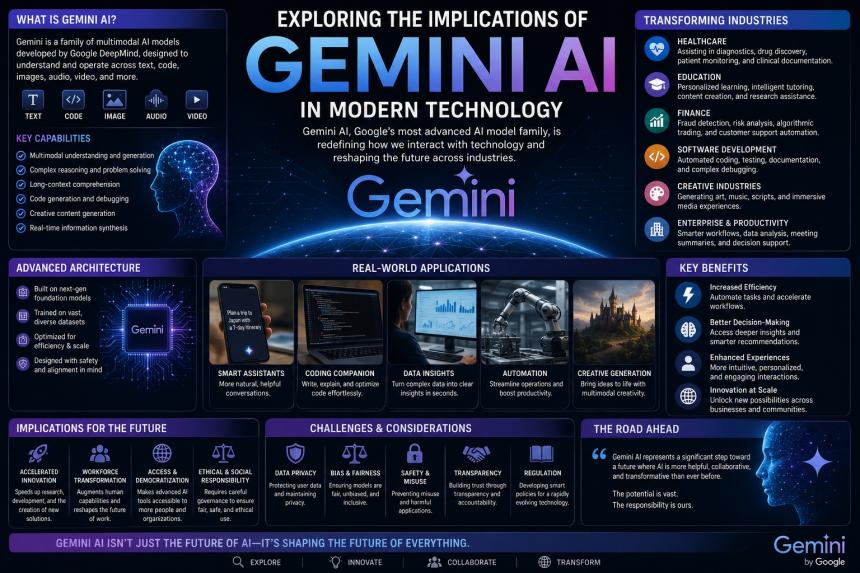
Gemini AI performs several functions across a wide array of tasks; it can play games and have conversations, compose music and draw pictures, study detailed instructions and complete a sequence of steps, create fictional stories and lay out newspaper pages, and much more. Conversations with Gemini may elicit jokes, guidance, spiritual insights, philosophical reflections, programming assistance, or simple replies to straightforward inquiries. Alongside its fantasy-like appeal, Gemini provides tools for a growing number of research, design, and decision-making activities.
Gemini represents a new wave of AI that is thereby gaining traction in the world of technology. A machine learning model and a computer interface that stand as a concept at once rich in imaginative possibilities and strong in practical utility. Demand often far exceeds supply on the world’s most popular large-scale AI systems, which are utilized in a multitude of creative settings including computer programming, digital artwork, advices on themes as wide as practical engineering design and spiritual reflection, and even now a agile shortcut access to the vast library of the Internet with the help of a Browser. Users may direct the AI with words and sentences and express desires, hopes, and rationality.
2. Gemini AI Unveiled: Form, Function, and Fantasia
Built on a colossal architecture with hundreds of models pooling their diverse strengths, Gemini reflects three important qualities. First, its design is not merely an expensive simulation of general or human-like intelligence, the value of which lies in the power of the mirror rather than its applied uses. Gemini enriches the human experience of creativity but offers practical benefits. Second, Gemini's interface enables people to explore tasks by mixing playfulness with purpose, fantasy with service. Third, the power of Gemini combines reflection with propulsion, creating surprising impacts on drivers' creativity and design, programming, and decision-support capacities. These characteristics justify exploration of the cutting-edge new offering and, by extension, the wider implications of Gemini-like technologies.
For example, Gemini accelerates multiple aspects of creative design and prototyping in engineering, architecture, aerodynamics, and other domains. The value-creation potential of game-playful, collaboratively exploratory interaction may, however, remain hidden for years. Other domains also benefit from the assistance of collaborative partners, with transformed needs for supporting skill-sets. Without fundamental shifts in education, training, and workforce development therefore, subsequent generations may struggle to find fulfilment and employment. Social, economic, political, emotional, and intellectual consequences extend well beyond obvious threats to privacy, trust, and surveillance.
3. Ethos and Ethics: Responsibility in a Responsive World
The fate of the human–technology partnership hinges on responsible action and on maintaining the qualities that define humanity in a technologically responsive world. Several ethical principles are central to the discussion: transparency, accountability, fairness, safety, and autonomy. Transparency requires clear disclosure of capabilities and limitations to enable informed decisions about trust and reliance. With increasing reliance comes increasing responsibility, which must be assigned to individuals and groups—developers, deployers, users, and affected parties. Mitigating bias and unintended consequences, and aligning behavior with human values, society's best interests, and established laws and norms create a foundation for trust. Failure to do so could precipitate a "trust gap," in which users of the technology begin to disbelieve or ignore the outputs, leading to dangerous misuses. Complicated situations are best addressed through granular consent processes and impact assessments that acknowledge the variable nature of risk across different contexts.
Many of Geminis's promising applications are in areas that remain emergent. It serves as a third collaborator in the creative process of artists, musicians, film-makers, writers, and designers, combining its cognitive and generative capabilities with the specialized skills and nuanced perspectives of these innovative groups. Lawyers and physicians leverage its memory and rapid retrieval to boost their productivity. In engineering and science, Gemini accelerates tedious tasks—detecting and fixing bugs, identifying poor-performing model parameters, performing sensitivity analysis, and suggesting design modifications—all of which let humans focus on more creative and less-menial aspects of the processes. For these reasons, Gemini's adoption and integration into such creative areas remain finite, limited by the delta of the perceived skill advantage, which in turn depends on organizational priorities, firm resources, and competitive dynamics.
4. Innovation at the Interface: Gemini as Catalyst
As the digital world burgeons with new complexities and uncharted horizons, creating, testing, and decision-making grow demanding and daunting. For designers and builders such processes are rife with intricacies that may be solved more quickly by devising a solution rather than by a pure discussion of possible solutions. Responding to this fundamental shift takes time-consuming resources. The beauty and grace of new science and engineering AIs lie in directing them toward the speed and hoist of these digital processes by the DREAM of the artworks. Like a dependable assistant, Gemini and similar large language models have the potential to animate such digital systems with immense and unseen forces.
Such a huge step has the power to demolish not just the apparent digital walls or ceilings, but the entire apparent artificial world. Removing barriers by reminding the effort of AI seems so abstract. A closer understanding would shed light on such roles. Paradoxically, Gemini shows that, in the physical world, walls are created by forces establishing pressure differences according to temperature differences. Whether driven by high-pressure zones or low-pressure zones, whether directed by other walls or structures, flows and currents travel freely toward connecting such pressure differences.
5. Societal Ripples: Work, Privacy, and Culture
The societal consequences of Gemini AI and its successors will ripple through four spheres: work, privacy, culture, erosion of trust, and the viability of existing information ecosystems. Many current jobs are already being supplemented and, in some cases, replaced by large language models. The Gemini family of AI systems boosts productivity when used as an assistant or tool: skilled users can accomplish tasks faster and to a higher standard than those working alone. It can also spur new kinds of jobs requiring less expertise because the AI can augment or complete incomplete ideas and vision.
Co-pilots will cause a shift in labor demand and productivity, leading to increased inequality as capital makes outsized accelerated returns and large swathes of the population lose jobs. Striking the right balance between safety and expansion of creative capabilities is a necessary waypoint along the coping path. A careful examination of privacy-related dangers is equally essential. The data generated through the use of these systems could, without sufficient regulation, fuel a mega-surveillance market (as has already occurred with social media platforms), threaten the social contract, and further exacerbate the growing divide in the ownership of knowledge and culture.
6. Governance and Trust: Safeguards in a Rising Paradigm
Responsibility and trustworthiness are paramount in shaping the emergence of any new capability. With Gemini’s potential for driving yet another leap in information technology, establishing the necessary safeguards is a pressing task. Various governance models, regulatory approaches, and standard-setting initiatives have been proposed and may be grouped into three broad categories: managing risk in responses to specific technologies, ensuring general preparedness in relation to class-based possibilities, and building trust through audit-and-certification frameworks.
A rising digital paradigm generates new risk landscapes. Although each major breakthrough brings significant new capabilities, it also widens the domain of possible dangers. Coping with the unequal pace of risk and response requires crowd-sourced monitoring and resilient adaptation. Recent developments in the field of risk management and incident response point toward new, more anticipatory possible solutions, enabling a resilient capacity for recovery. Long-tail uncertainties associated with complex assemblages of social, mechanical, and biological systems, such as deeply-seated and long-neglected knowledge-holders, local realities, and long-term human relationships, inevitably remain a source of vulnerability. These paradoxes call for an adaptive, investigative, learning-oriented governance approach that supplements rather than displaces compliance-driven responses.
7. Creative Collaboration: Artists, Engineers, and Gemini
Quantitative examinations of the Gemini AI Nexus reveal that it democratizes artistic expression by erasing barriers between hobbyists and experts across disciplines. The Nexus generates visual images, music, videos, and 3D models. It enables artists, architects, engineers, game designers, and other storytellers to brainstorm ideas and execute production-ready prototypes of sophisticated imaginative worlds, engaging audience interest and investment. Gaming companies use it to sketch and prototype aesthetic elements and tasks. Furthermore, software engineers leverage the Nexus to simplify testing, documentation, and code generation.
The collaboration between people and the Nexus extends to co-creation with AI-generated assets—artworks and embodied intelligences formed within the creative Nexus of AIs. The blend of human inspiration and AI enablement facilitates artistic expression, accelerating both design work and its completion. In the process, a new kind of artist emerges: those who design the structure of the artwork, and those who delegate the actual execution to embodied machine learning intelligences. The boundaries of programming are crossed and erased; people increasingly program through natural conversations and gestures, and images. Just as configuration is separated from the product within the modern supply chain, the same happens with artworks, design works, novels, movies, games, and music. Yet, even now, articulating a prompt for a text-to-image generator is a unique skill; so is choosing quality assets—music, dialogue, language, and voice—for a visual novel.
8. Risks, Resilience, and Recovery: Navigating the Unknown
The exploration of technological frontiers is fraught with perils and uncertainties. The deployment of Gemini and other leading-edge systems triggers operational risks—elevated chances of unacceptable behavior, interaction failure, or sensitive data leaks—while also generating ethical, societal, and privacy concerns. Some dangers can be prudently managed; others elude comprehensive foresight and must therefore be approached with resilience and an emphasis on recovery. A framework categorizing risks according to their likelihood and impact aids in assigning priorities, and accompanying recovery rituals help mitigate the fallout of worst-case scenarios.
As Gemini and similar technology continue shaping the world, the focus must widen to encompass a broad range of potential consequences—both beneficial and malign, certain and uncertain. In addition to interpersonal trust, intellectual property, and privacy issues, a longer list of social risks accompanies the introduction of new systems, identified by position along two axes indicating probability and harm. Perhaps the most iconic of the many warnings sounded in recent months involves the broad-ranging consequences of advanced models for the conduct, nature, and enjoyment of creative work.
9. The Future We Craft: Scenarios and Souls
Developing plausible future scenarios improves understanding of Gemini AI's roles—and helps steer trajectories toward preferred outcomes. Three futures emerge: affirmative, resisting, and transforming. Each links technological developments to human meanings.
In an optimistic scenario, Gemini AI and its kin act like digital genies, reflecting their users’ desires, amplifying creativity, and enhancing well-being. Proprietary and open-source implementations coexist, enabling diverse communities to flourish. Employment continues its shift from routine work to creative endeavors; productivity increases and working hours decline. Effectively engineered social and economic policies ensure broad access to wealth and opportunity. Gemini’s modality-bending capabilities stimulate a renaissance in artistic expression; the recasting of information processing cultivates awareness of trustworthiness.
A more cautious perspective perceives Gemini as a helpful but risky tool. Simulation and speculation dominate adoption. Task-oriented mirroring becomes commonplace but only for reliable operators. Memetic holograms deliver news in rich, vivid forms, but at the cost of greater information chaos. Actors with power and privileged access deploy Gemini-assisted digital puppetry to manipulate adherents; society becomes more polarized and fragile as falsehoods proliferate. Distrust in institutions and insecurity about the future grow, sparking demands for escape in drugs, violence, or self-destruction.
10. Conclusion
Although Gemini AI is a mirror of human capabilities, it is also a motor that propels evolution across fields of thought and action. This dance with technology raises questions about trust and responsibility: Can the use of Gemini AI for online information-gathering and decision-support be adequately governed so that the results are effective, accurate, and socially responsible? The answer will shape the future of organizations, regions, and society at large.
Practical explorations of Gemini AI have identified a variety of new resources, risks, and prudential guidelines. Magnetically safe and beneficial flows of change demand a foundation of data integrity, skill development, and proactive governance. Multiple plausible scenarios depict the form that online information-gathering may take in the years ahead, from cautious adaptation that reinforces existing conditions to radical transformation that spawns new modes of expression and creativity. Ultimately, the future course of these technologies, like that of all intelligent tools, will be determined by the meanings, values, and aspirations humans choose to pursue. Fostering desirable outcomes requires conscious awareness of emerging decision points and the actions they invite, harnessed through collective agency and foresight.